You are here
Last updated at October 28, 2026 by Teachoo
Transcript
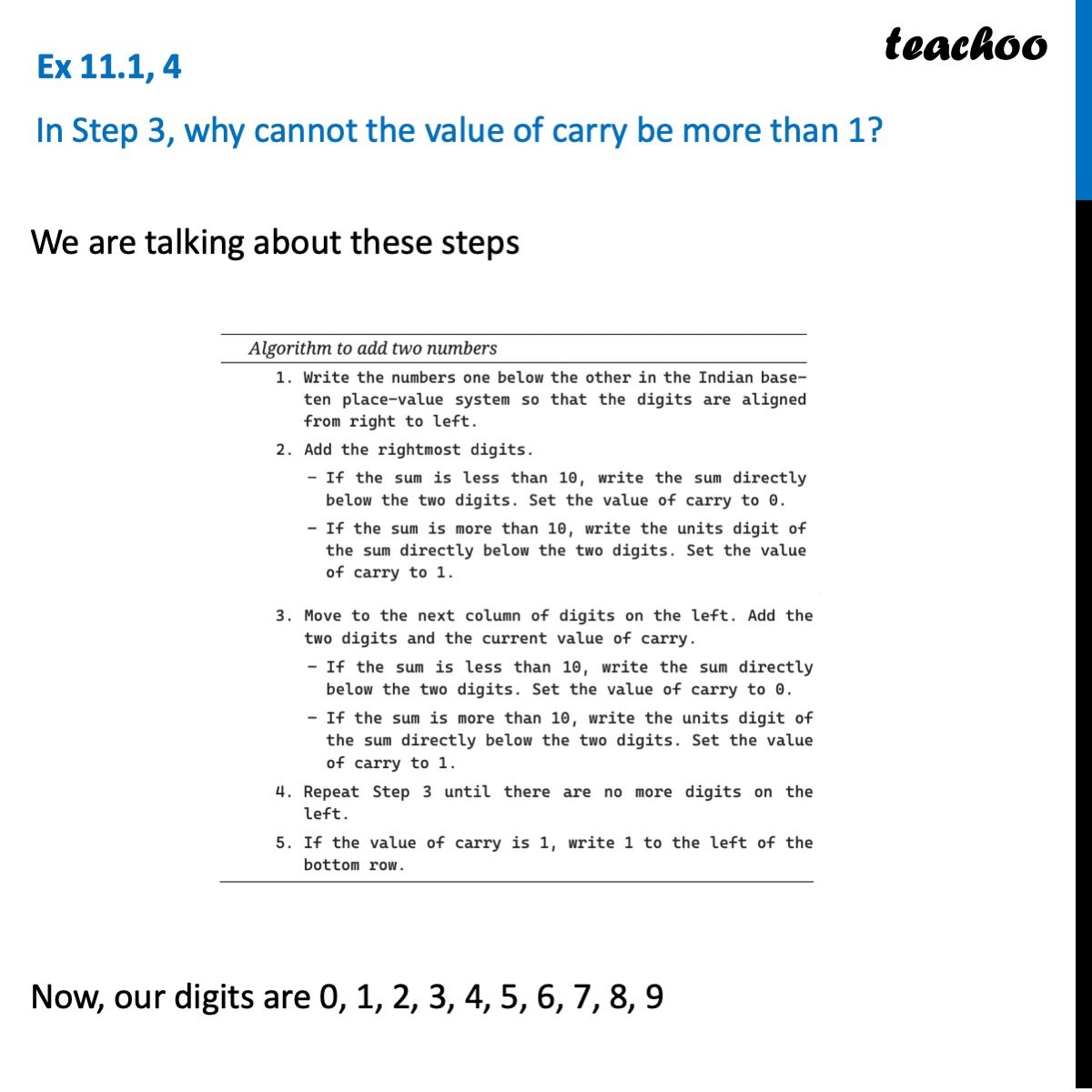
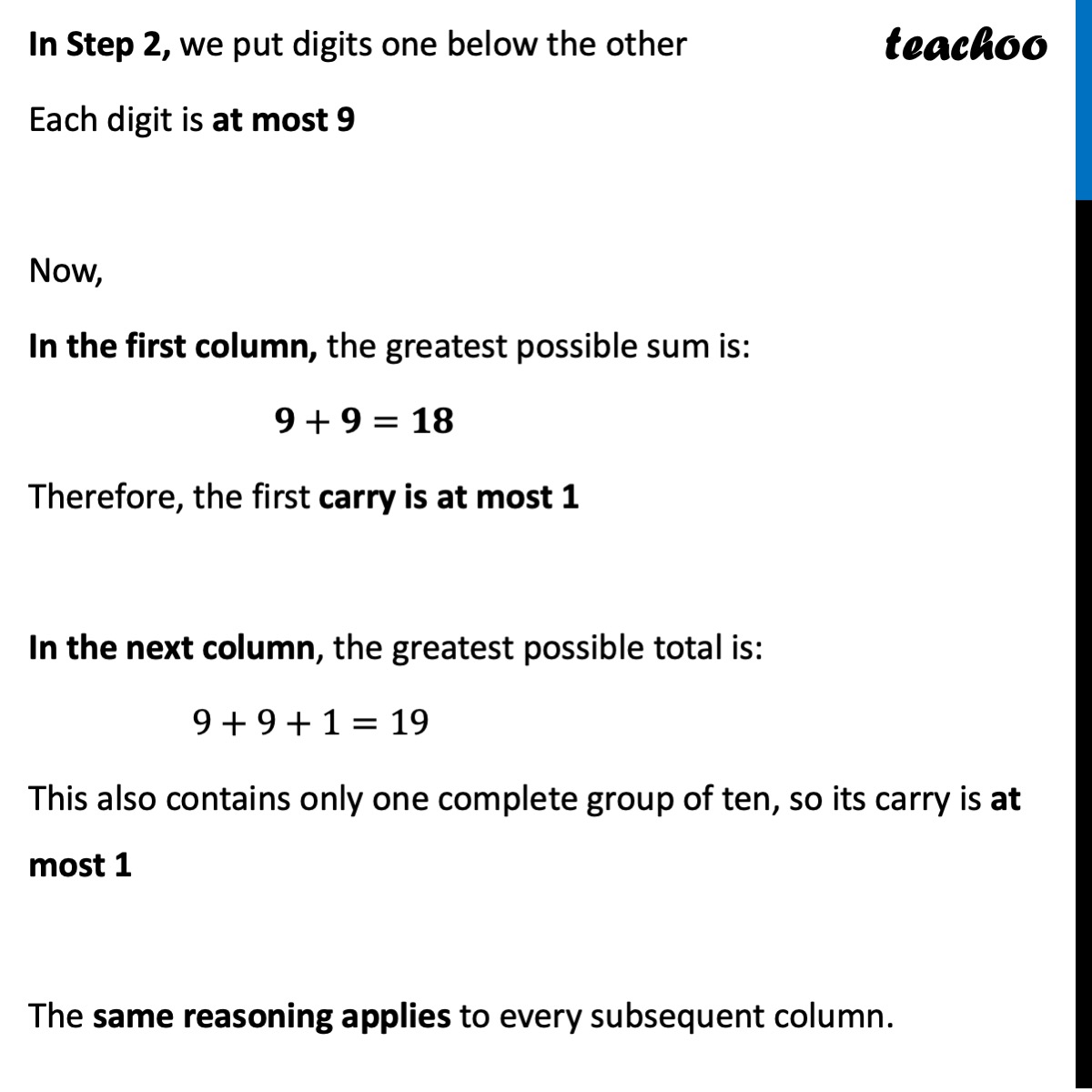
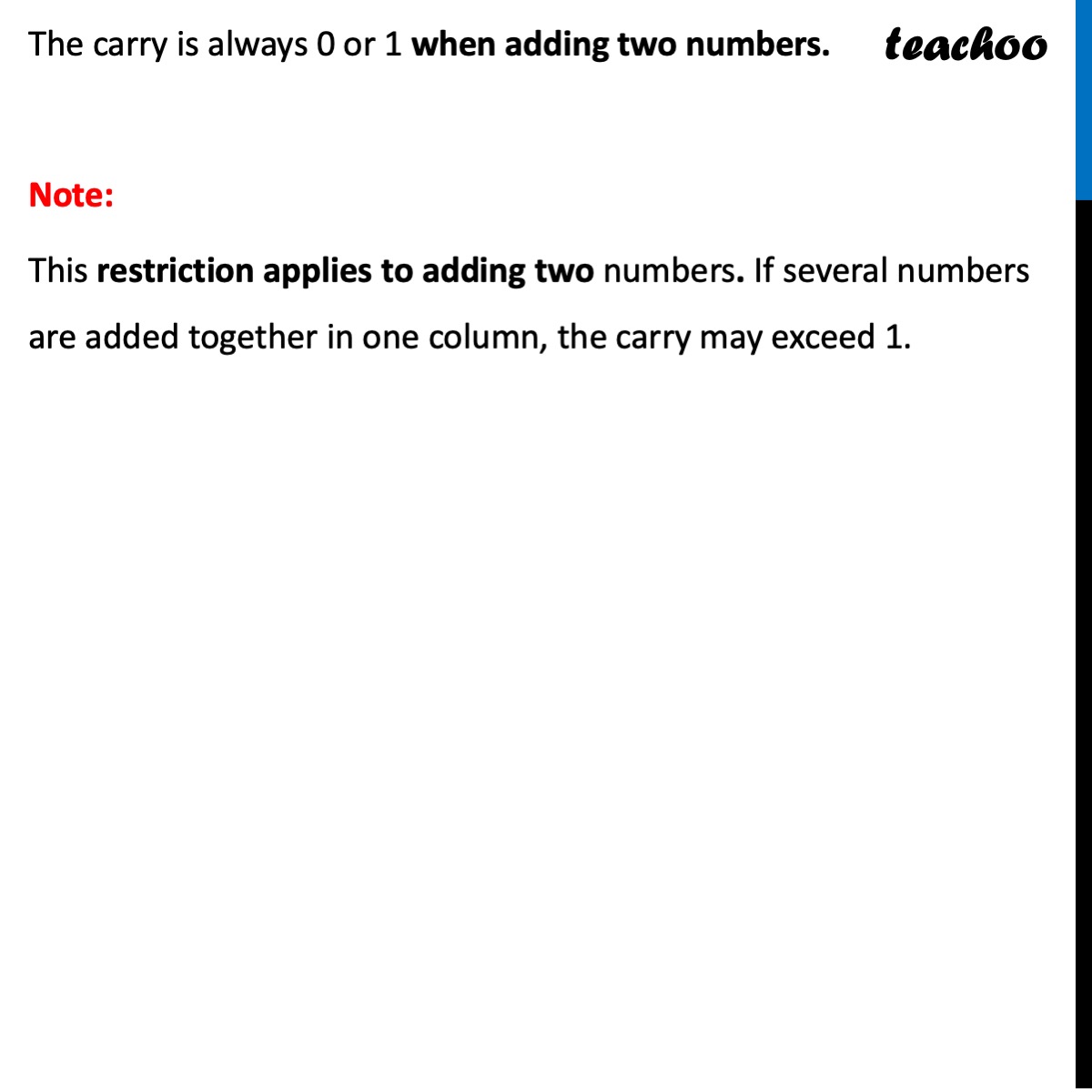
Ex 11.1, 4 In Step 3, why cannot the value of carry be more than 1? We are talking about these steps Now, our digits are 0, 1, 2, 3, 4, 5, 6, 7, 8, 9 Algorithm to add two numbers 1. Write the numbers one below the other in the Indian base- ten place-value system so that the digits are aligned from right to left. . Add the rightmost digits. -— If the sum is less than 10, write the sum directly below the two digits. Set the value of carry to 0. — If the sum is more than 10, write the units digit of the sum directly below the two digits. Set the value of carry to 1. . Move to the next column of digits on the left. Add the two digits and the current value of carry. . Repeat Step 3 until there are no more digits on the left. . If the value of carry is 1, write 1 to the left of the bottom row. In Step 2, we put digits one below the other Each digit is at most 9 Now, In the first column, the greatest possible sum is: 𝟗+𝟗=𝟏𝟖 Therefore, the first carry is at most 1 In the next column, the greatest possible total is: 9+9+1=19 This also contains only one complete group of ten, so its carry is at most 1 The same reasoning applies to every subsequent column. The carry is always 0 or 1 when adding two numbers. Note: This restriction applies to adding two numbers. If several numbers are added together in one column, the carry may exceed 1. The carry is always 0 or 1 when adding two numbers. Note: This restriction applies to adding two numbers. If several numbers are added together in one column, the carry may exceed 1.