You are here
Last updated at October 28, 2026 by Teachoo
Transcript
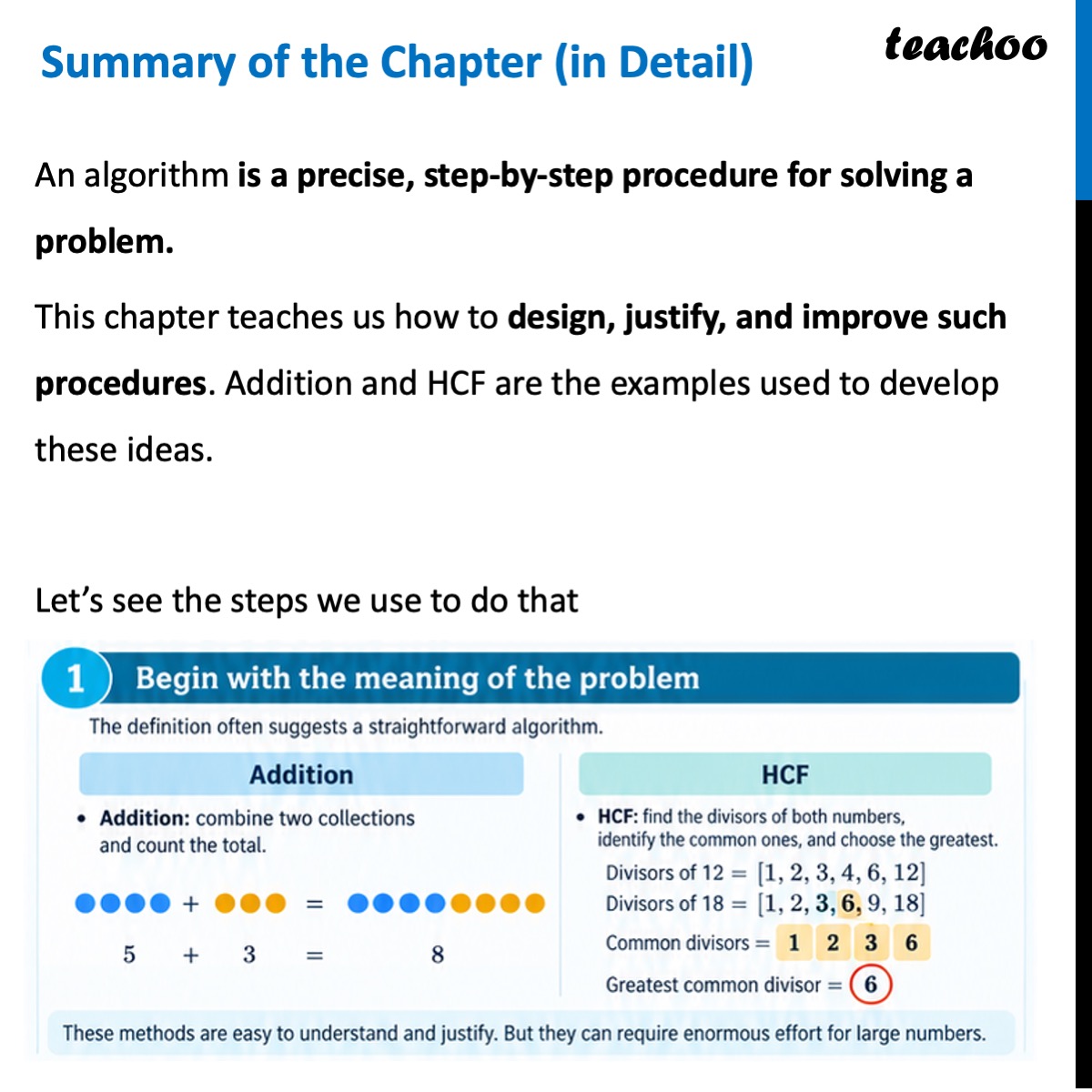
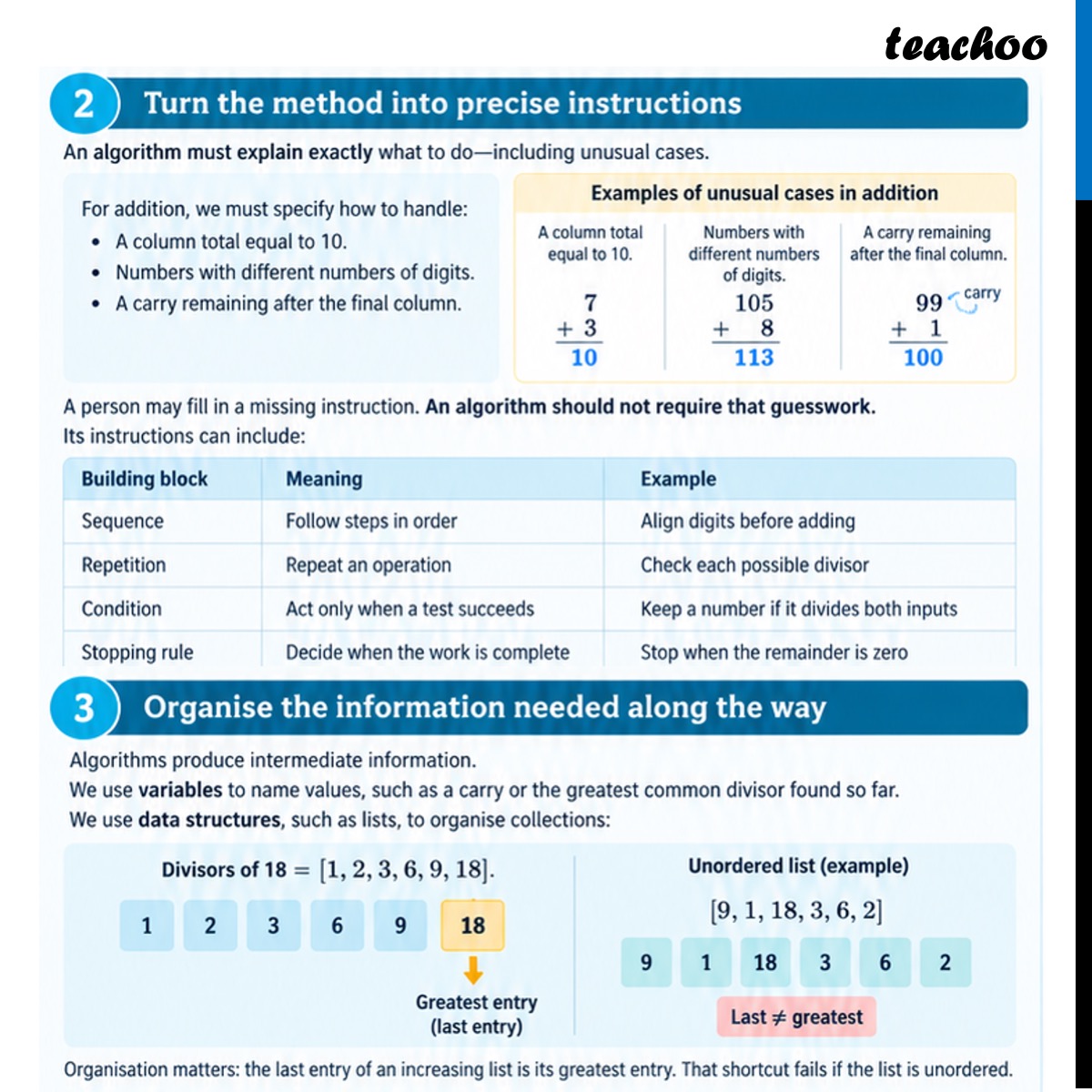
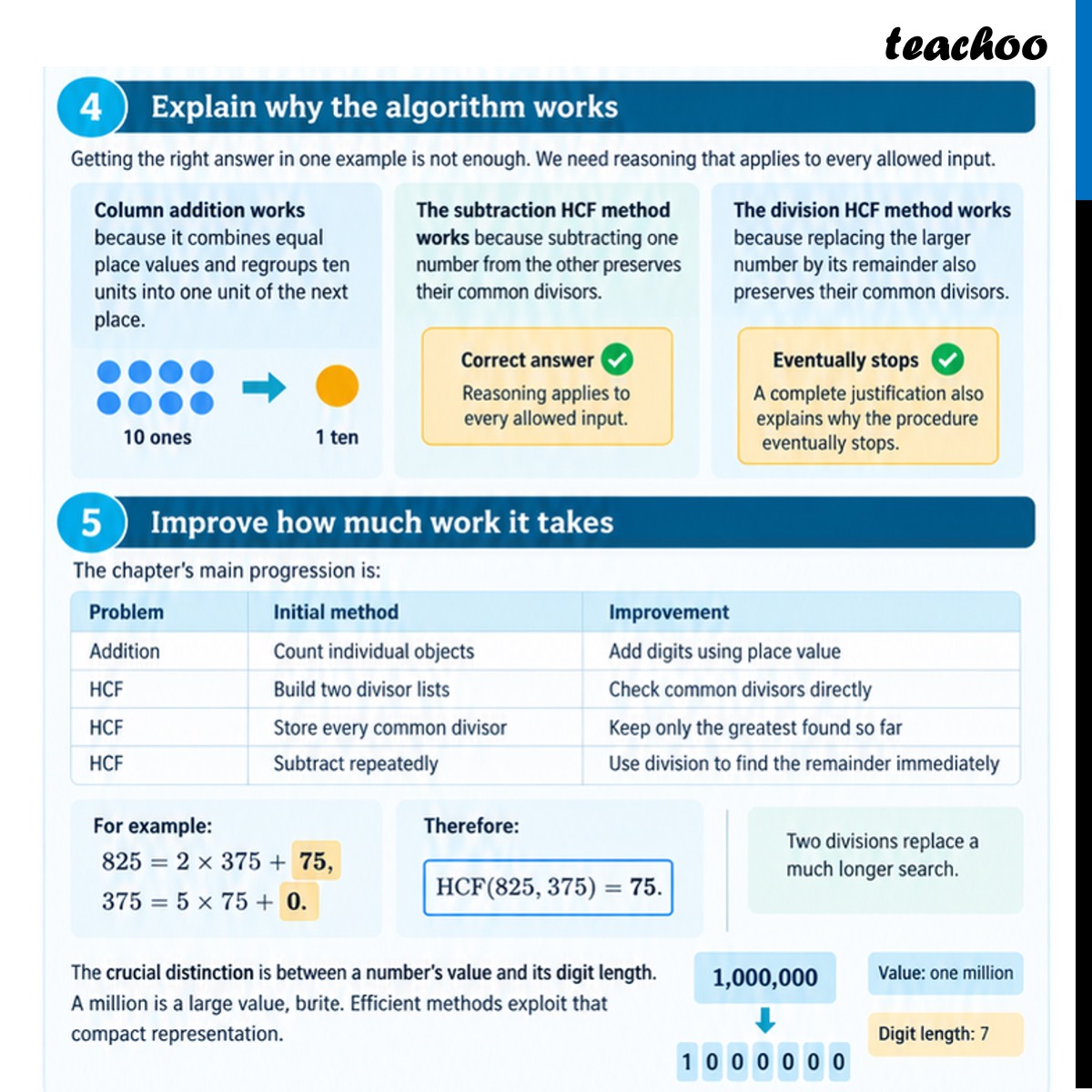
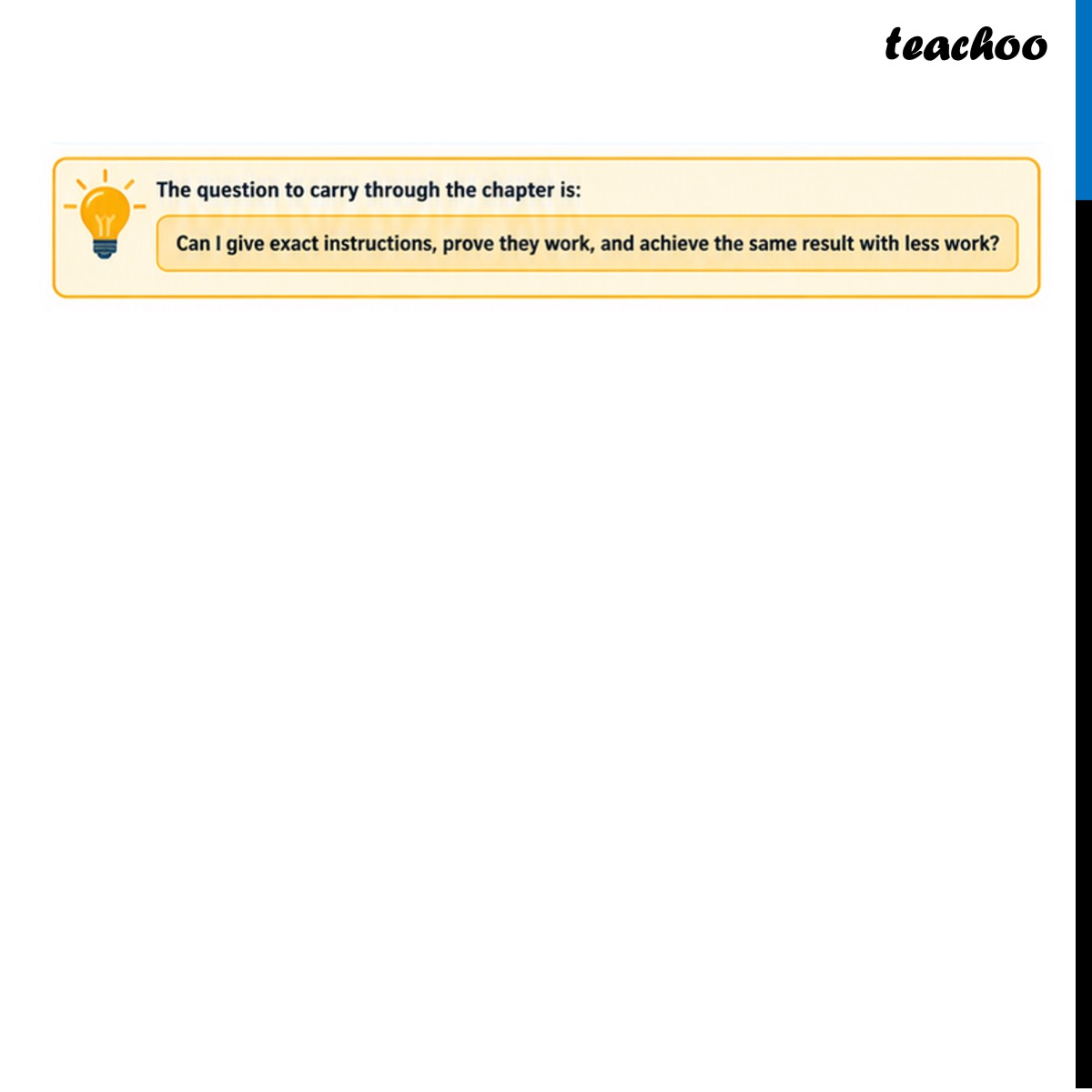
Summary of the Chapter (in Detail) An algorithm is a precise, step-by-step procedure for solving a problem. This chapter teaches us how to design, justify, and improve such procedures. Addition and HCF are the examples used to develop these ideas. Let’s see the steps we use to do that THE WORLD OF ALGORITHMS Design - Justify - Improve An algorithm is a precise, step-by-step procedure for solving a problem. It uses basic operations we already know, specifies when to repeat or make a decision, and eventually produces an answer. This chapter teaches us how to design, justify, and improve such procedures. Addition and HCF are the examples used to develop these ideas. C1) Begin with the meaning of the problem The definition often suggests a straightforward algorithm. Addition HCF * Addition: combine two collections ‘© HF: find the divisors of both numbers, and count the total. identify the common ones, and choose the greatest. Divisors of 12 = [1, 2, 3, 4, 6, 12] ©00@+ eee = Divisors of 18 = [1, 2, 3, 6, 9, 18] Common divisors= 1 2 3 6 Greatest common divisor 5 Caer " cy These methods are easy to understand and justify. But they can require enormous effort for large numbers. 2) Turn the method into precise instructions An algorithm must explain exactly what to do—including unusual cases. For addition, we must specify how to handle: } eapiplgs ch unusil caees in sedition ] @ Aacurisilega tt i | *Seaero | acceeaines | aniucuel tetas * Numbers with different numbers of digits. of digits. © carry remaining after the final column, id 105 9943 +3 + 8 +1 10 113 100 A person may fill in a missing instruction. An algorithm should not require that guesswork. Its instructions can include: Building block Meaning Example ‘Sequence Follow steps in order Align digits before adding Repetition Repeat an operation Check each possible divisor Condition Act only when a test succeeds Keep a number fit divides both inputs Stopping rule Decide when the work is complete Stop when the remainder is zero C3 ) Organise the information needed along the way Algorithms produce intermediate information. We use variables to name values, such as a carry or the greatest common divisor found so far. We use data structures, such as lists, to organise collections: Divisors of 18 = (1, 2, 3, 6, 9, 18}. Unordered list (example) 7 Oa) a a co (9, 1, 18, 3, 6, 2] 4 9) a 8) Ws 6 2 Greatest entry (last entry) Last # greatest Organisation matters: the last entry of an increasing lists its greatest entry. That shortcut fails ifthe list is unordered. 4 ) Explain why the algorithm works Getting the right answer in one example is not enough. We need reasoning that applies to every allowed input. Column addition works The subtraction HCF method The division HCF method works because it combines equal works because subtracting one _because replacing the larger place values and regroups ten number from the other preserves number by its remainder also units into one unit of the next their common divisors. preserves their common divisors. place. e00ee@ e000 10 ones C5) Improve how much work it takes The chapter's main progression is: Problem Initial method Improvement Addition Count individual objects ‘Add digits using place value HCF Build two divisor lists Check common divisors directly HCF Store every common divisor Keep only the greatest found so far HCF Subtract repeatedly Use division to find the remainder immediately For example: Therefore: ‘Two divisions replace a 825 = 2x 375 + 75, ante Ea much longer search, 375 =5x 75 +0. The crucial distinction is between a number's value and its digit length. 1,900,000 —_Value: one million Amillion isa large value, buite. Efficient methods exploit that ¢ ‘compact representation. + Digit length: 7 1000000 ~— ¢ The question to carry through the chapter THE WORLD OF ALGORITHMS Design - Justify - Improve An algorithm is a precise, step-by-step procedure for solving a problem. It uses basic operations we already know, specifies when to repeat or make a decision, and eventually produces an answer. This chapter teaches us how to design, justify, and improve such procedures. Addition and HCF are the examples used to develop these ideas. C1) Begin with the meaning of the problem The definition often suggests a straightforward algorithm. Addition HCF * Addition: combine two collections ‘© HF: find the divisors of both numbers, and count the total. identify the common ones, and choose the greatest. Divisors of 12 = [1, 2, 3, 4, 6, 12] ©00@+ eee = Divisors of 18 = [1, 2, 3, 6, 9, 18] Common divisors= 1 2 3 6 Greatest common divisor 5 Caer " cy These methods are easy to understand and justify. But they can require enormous effort for large numbers. 2) Turn the method into precise instructions An algorithm must explain exactly what to do—including unusual cases. For addition, we must specify how to handle: } eapiplgs ch unusil caees in sedition ] @ Aacurisilega tt i | *Seaero | acceeaines | aniucuel tetas * Numbers with different numbers of digits. of digits. © carry remaining after the final column, id 105 9943 +3 + 8 +1 10 113 100 A person may fill in a missing instruction. An algorithm should not require that guesswork. Its instructions can include: Building block Meaning Example ‘Sequence Follow steps in order Align digits before adding Repetition Repeat an operation Check each possible divisor Condition Act only when a test succeeds Keep a number fit divides both inputs Stopping rule Decide when the work is complete Stop when the remainder is zero C3 ) Organise the information needed along the way Algorithms produce intermediate information. We use variables to name values, such as a carry or the greatest common divisor found so far. We use data structures, such as lists, to organise collections: Divisors of 18 = (1, 2, 3, 6, 9, 18}. Unordered list (example) 7 Oa) a a co (9, 1, 18, 3, 6, 2] 4 9) a 8) Ws 6 2 Greatest entry (last entry) Last # greatest Organisation matters: the last entry of an increasing lists its greatest entry. That shortcut fails ifthe list is unordered. 4 ) Explain why the algorithm works Getting the right answer in one example is not enough. We need reasoning that applies to every allowed input. Column addition works The subtraction HCF method The division HCF method works because it combines equal works because subtracting one _because replacing the larger place values and regroups ten number from the other preserves number by its remainder also units into one unit of the next their common divisors. preserves their common divisors. place. e00ee@ e000 10 ones C5) Improve how much work it takes The chapter's main progression is: Problem Initial method Improvement Addition Count individual objects ‘Add digits using place value HCF Build two divisor lists Check common divisors directly HCF Store every common divisor Keep only the greatest found so far HCF Subtract repeatedly Use division to find the remainder immediately For example: Therefore: ‘Two divisions replace a 825 = 2x 375 + 75, ante Ea much longer search, 375 =5x 75 +0. The crucial distinction is between a number's value and its digit length. 1,900,000 —_Value: one million Amillion isa large value, buite. Efficient methods exploit that ¢ ‘compact representation. + Digit length: 7 1000000 ~— ¢ The question to carry through the chapter THE WORLD OF ALGORITHMS Design - Justify - Improve An algorithm is a precise, step-by-step procedure for solving a problem. It uses basic operations we already know, specifies when to repeat or make a decision, and eventually produces an answer. This chapter teaches us how to design, justify, and improve such procedures. Addition and HCF are the examples used to develop these ideas. C1) Begin with the meaning of the problem The definition often suggests a straightforward algorithm. Addition HCF * Addition: combine two collections ‘© HF: find the divisors of both numbers, and count the total. identify the common ones, and choose the greatest. Divisors of 12 = [1, 2, 3, 4, 6, 12] ©00@+ eee = Divisors of 18 = [1, 2, 3, 6, 9, 18] Common divisors= 1 2 3 6 Greatest common divisor 5 Caer " cy These methods are easy to understand and justify. But they can require enormous effort for large numbers. 2) Turn the method into precise instructions An algorithm must explain exactly what to do—including unusual cases. For addition, we must specify how to handle: } eapiplgs ch unusil caees in sedition ] @ Aacurisilega tt i | *Seaero | acceeaines | aniucuel tetas * Numbers with different numbers of digits. of digits. © carry remaining after the final column, id 105 9943 +3 + 8 +1 10 113 100 A person may fill in a missing instruction. An algorithm should not require that guesswork. Its instructions can include: Building block Meaning Example ‘Sequence Follow steps in order Align digits before adding Repetition Repeat an operation Check each possible divisor Condition Act only when a test succeeds Keep a number fit divides both inputs Stopping rule Decide when the work is complete Stop when the remainder is zero C3 ) Organise the information needed along the way Algorithms produce intermediate information. We use variables to name values, such as a carry or the greatest common divisor found so far. We use data structures, such as lists, to organise collections: Divisors of 18 = (1, 2, 3, 6, 9, 18}. Unordered list (example) 7 Oa) a a co (9, 1, 18, 3, 6, 2] 4 9) a 8) Ws 6 2 Greatest entry (last entry) Last # greatest Organisation matters: the last entry of an increasing lists its greatest entry. That shortcut fails ifthe list is unordered. 4 ) Explain why the algorithm works Getting the right answer in one example is not enough. We need reasoning that applies to every allowed input. Column addition works The subtraction HCF method The division HCF method works because it combines equal works because subtracting one _because replacing the larger place values and regroups ten number from the other preserves number by its remainder also units into one unit of the next their common divisors. preserves their common divisors. place. e00ee@ e000 10 ones C5) Improve how much work it takes The chapter's main progression is: Problem Initial method Improvement Addition Count individual objects ‘Add digits using place value HCF Build two divisor lists Check common divisors directly HCF Store every common divisor Keep only the greatest found so far HCF Subtract repeatedly Use division to find the remainder immediately For example: Therefore: ‘Two divisions replace a 825 = 2x 375 + 75, ante Ea much longer search, 375 =5x 75 +0. The crucial distinction is between a number's value and its digit length. 1,900,000 —_Value: one million Amillion isa large value, buite. Efficient methods exploit that ¢ ‘compact representation. + Digit length: 7 1000000 ~— ¢ The question to carry through the chapter THE WORLD OF ALGORITHMS Design - Justify - Improve An algorithm is a precise, step-by-step procedure for solving a problem. It uses basic operations we already know, specifies when to repeat or make a decision, and eventually produces an answer. This chapter teaches us how to design, justify, and improve such procedures. Addition and HCF are the examples used to develop these ideas. C1) Begin with the meaning of the problem The definition often suggests a straightforward algorithm. Addition HCF * Addition: combine two collections ‘© HF: find the divisors of both numbers, and count the total. identify the common ones, and choose the greatest. Divisors of 12 = [1, 2, 3, 4, 6, 12] ©00@+ eee = Divisors of 18 = [1, 2, 3, 6, 9, 18] Common divisors= 1 2 3 6 Greatest common divisor 5 Caer " cy These methods are easy to understand and justify. But they can require enormous effort for large numbers. 2) Turn the method into precise instructions An algorithm must explain exactly what to do—including unusual cases. For addition, we must specify how to handle: } eapiplgs ch unusil caees in sedition ] @ Aacurisilega tt i | *Seaero | acceeaines | aniucuel tetas * Numbers with different numbers of digits. of digits. © carry remaining after the final column, id 105 9943 +3 + 8 +1 10 113 100 A person may fill in a missing instruction. An algorithm should not require that guesswork. Its instructions can include: Building block Meaning Example ‘Sequence Follow steps in order Align digits before adding Repetition Repeat an operation Check each possible divisor Condition Act only when a test succeeds Keep a number fit divides both inputs Stopping rule Decide when the work is complete Stop when the remainder is zero C3 ) Organise the information needed along the way Algorithms produce intermediate information. We use variables to name values, such as a carry or the greatest common divisor found so far. We use data structures, such as lists, to organise collections: Divisors of 18 = (1, 2, 3, 6, 9, 18}. Unordered list (example) 7 Oa) a a co (9, 1, 18, 3, 6, 2] 4 9) a 8) Ws 6 2 Greatest entry (last entry) Last # greatest Organisation matters: the last entry of an increasing lists its greatest entry. That shortcut fails ifthe list is unordered. 4 ) Explain why the algorithm works Getting the right answer in one example is not enough. We need reasoning that applies to every allowed input. Column addition works The subtraction HCF method The division HCF method works because it combines equal works because subtracting one _because replacing the larger place values and regroups ten number from the other preserves number by its remainder also units into one unit of the next their common divisors. preserves their common divisors. place. e00ee@ e000 10 ones C5) Improve how much work it takes The chapter's main progression is: Problem Initial method Improvement Addition Count individual objects ‘Add digits using place value HCF Build two divisor lists Check common divisors directly HCF Store every common divisor Keep only the greatest found so far HCF Subtract repeatedly Use division to find the remainder immediately For example: Therefore: ‘Two divisions replace a 825 = 2x 375 + 75, ante Ea much longer search, 375 =5x 75 +0. The crucial distinction is between a number's value and its digit length. 1,900,000 —_Value: one million Amillion isa large value, buite. Efficient methods exploit that ¢ ‘compact representation. + Digit length: 7 1000000 ~— ¢ The question to carry through the chapter