
 You are here
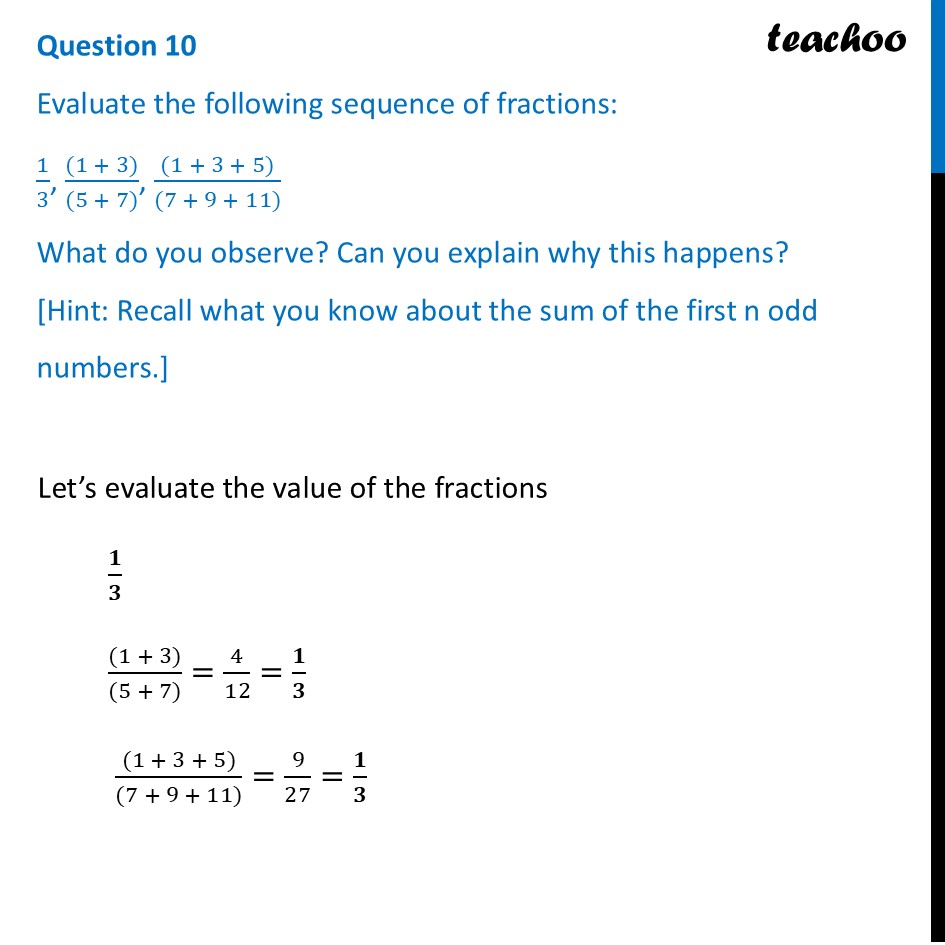
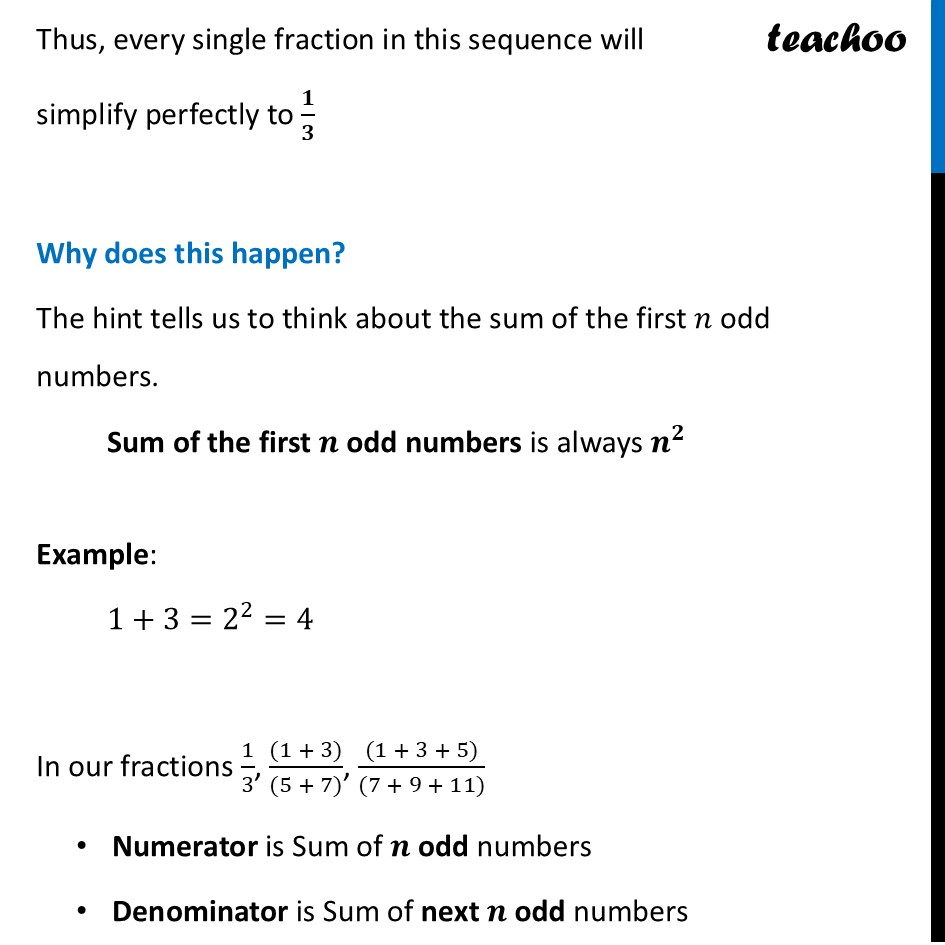
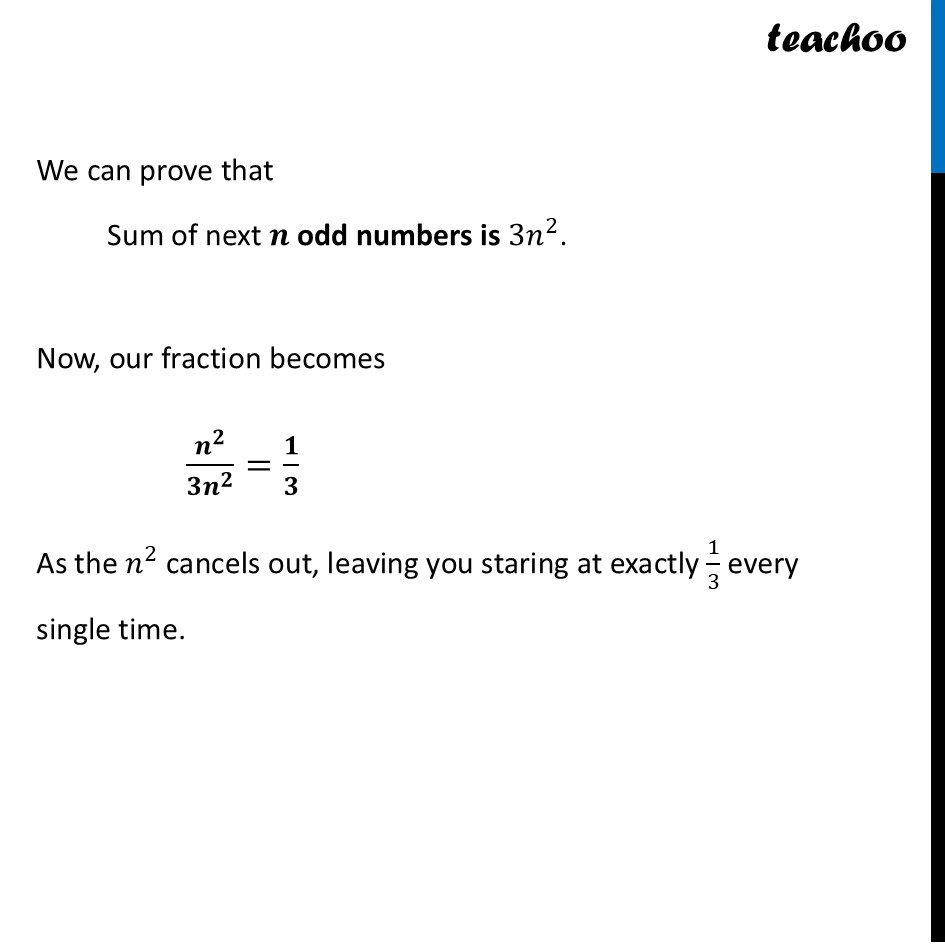
Figure it out - Page 145-147
Last updated at March 6, 2026 by Teachoo
Transcript
Question 10 Evaluate the following sequence of fractions: 1/3, ((1 + 3))/((5 + 7)), ((1 + 3 + 5))/((7 + 9 + 11)) What do you observe? Can you explain why this happens? [Hint: Recall what you know about the sum of the first n odd numbers.]Let’s evaluate the value of the fractions 𝟏/𝟑 ((1 + 3))/((5 + 7))=4/12=𝟏/𝟑 ((1 + 3 + 5))/((7 + 9 + 11))=9/27=𝟏/𝟑 Thus, every single fraction in this sequence will simplify perfectly to 𝟏/𝟑 Why does this happen? The hint tells us to think about the sum of the first 𝑛 odd numbers. Sum of the first 𝒏 odd numbers is always 𝒏^𝟐 Example: 1+3=2^2=4 In our fractions 1/3, ((1 + 3))/((5 + 7)), ((1 + 3 + 5))/((7 + 9 + 11)) Numerator is Sum of 𝒏 odd numbers Denominator is Sum of next 𝒏 odd numbers We can prove that Sum of next 𝒏 odd numbers is 3𝑛^2. Now, our fraction becomes 𝒏^𝟐/(𝟑𝒏^𝟐 )=𝟏/𝟑 As the 𝑛^2 cancels out, leaving you staring at exactly 1/3 every single time. We can prove that Sum of next 𝒏 odd numbers is 3𝑛^2. Now, our fraction becomes 𝒏^𝟐/(𝟑𝒏^𝟐 )=𝟏/𝟑 As the 𝑛^2 cancels out, leaving you staring at exactly 1/3 every single time.
