 You are here

![Decoding Divisibility Tricks - [Class 8 Ganita Prakash Part 2] - Decoding Divisibility Tricks](https://cdn.teachoo.com/dc9bee33-14f9-4ecc-802b-ede8b90a6978/slide84.jpg)
Decoding Divisibility Tricks
Decoding Divisibility Tricks
Last updated at March 6, 2026 by Teachoo
Transcript
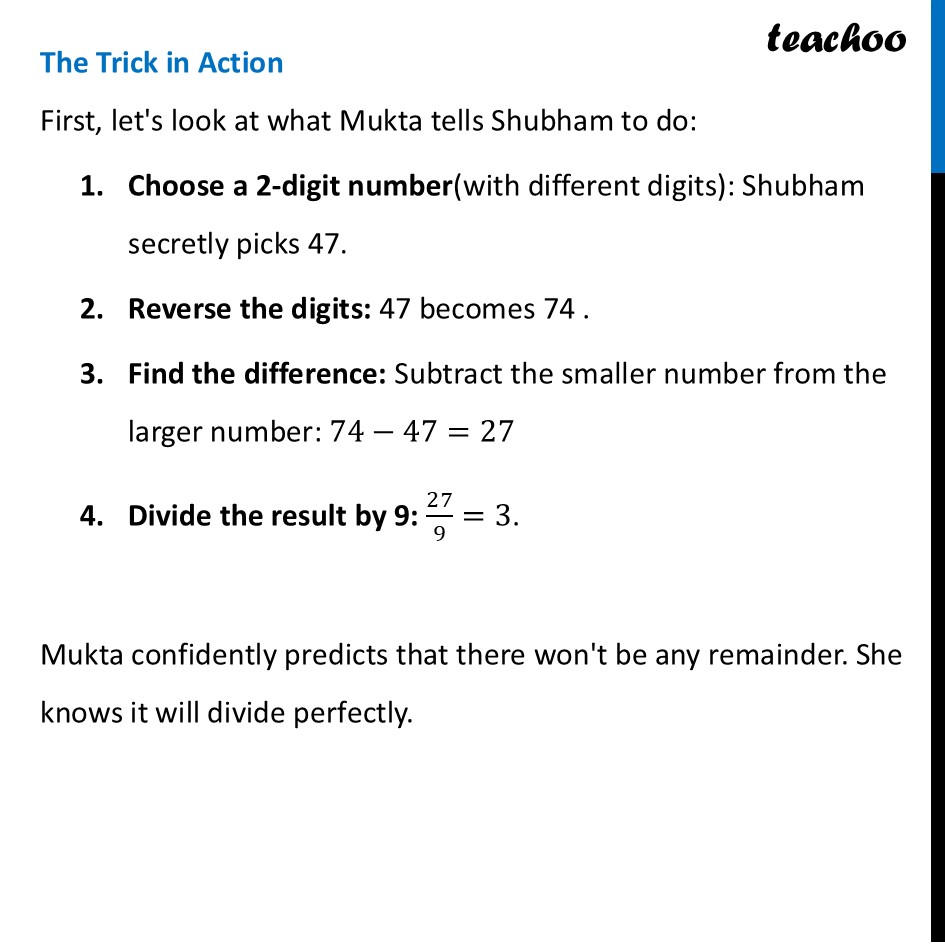
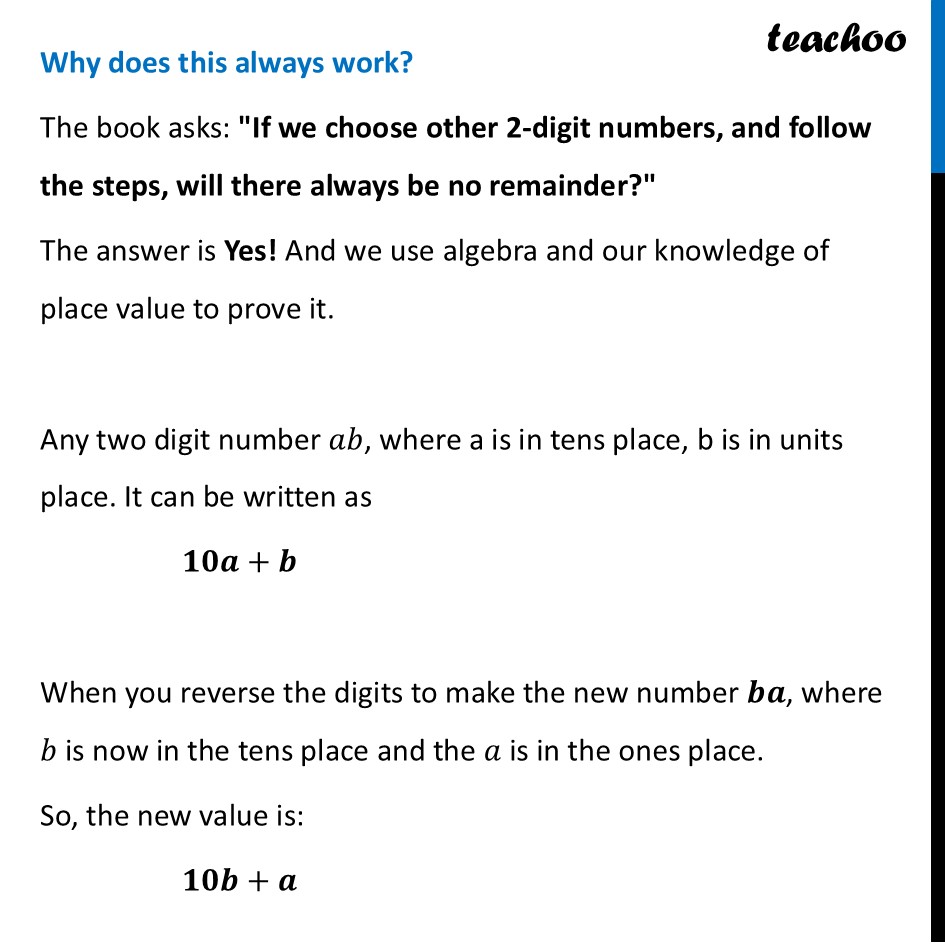
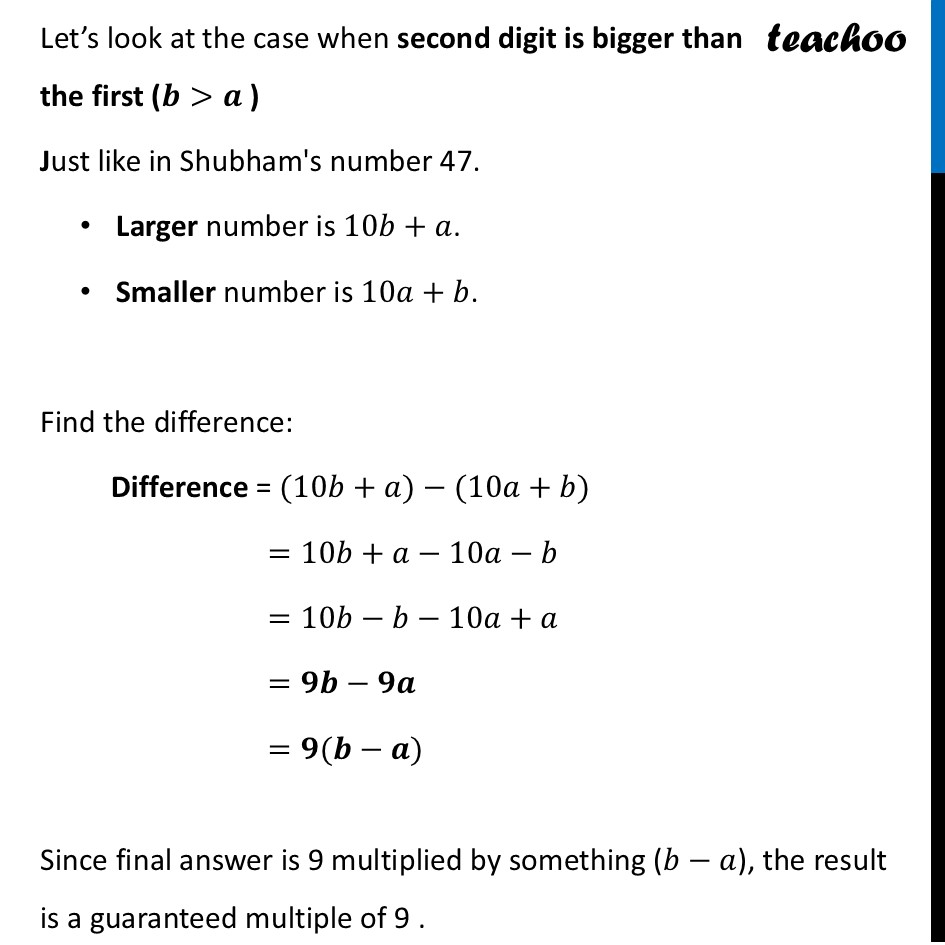
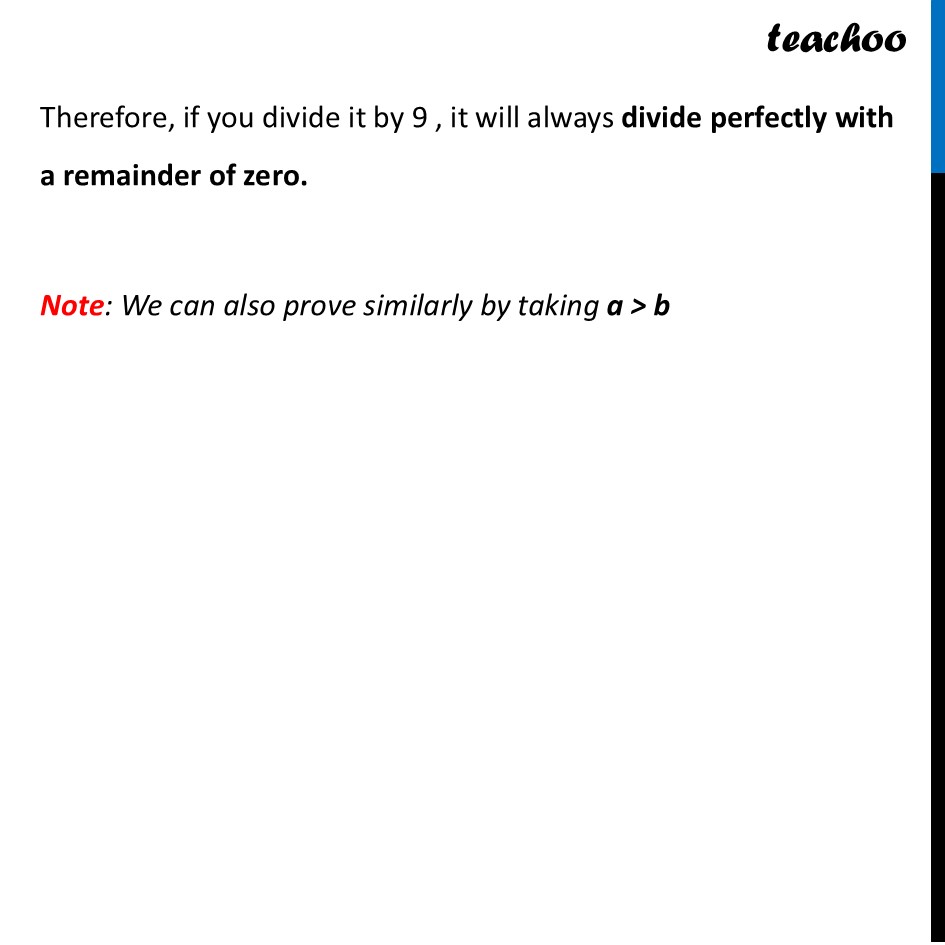
Decoding Divisibility TricksMukta is performing a mind-reading trick, but just like the "Think of a Number" trick we did earlier, it is secretly just algebra in a clever disguise. The Trick in Action First, let's look at what Mukta tells Shubham to do: Choose a 2-digit number(with different digits): Shubham secretly picks 47. Reverse the digits: 47 becomes 74 . Find the difference: Subtract the smaller number from the larger number: 74−47=27 Divide the result by 9: 27/9=3. Mukta confidently predicts that there won't be any remainder. She knows it will divide perfectly. Why does this always work? The book asks: "If we choose other 2-digit numbers, and follow the steps, will there always be no remainder?" The answer is Yes! And we use algebra and our knowledge of place value to prove it. Any two digit number 𝑎𝑏, where a is in tens place, b is in units place. It can be written as 𝟏𝟎𝒂+𝒃 When you reverse the digits to make the new number 𝒃𝒂, where 𝑏 is now in the tens place and the 𝑎 is in the ones place. So, the new value is: 𝟏𝟎𝒃+𝒂 Let’s look at the case when second digit is bigger than the first (𝒃>𝒂 ) Just like in Shubham's number 47. Larger number is 10𝑏+𝑎. Smaller number is 10𝑎+𝑏. Find the difference: Difference = (10𝑏+𝑎)−(10𝑎+𝑏) =10𝑏+𝑎−10𝑎−𝑏 =10𝑏−𝑏−10𝑎+𝑎 =𝟗𝒃−𝟗𝒂 =𝟗(𝒃−𝒂) Since final answer is 9 multiplied by something (𝑏−𝑎), the result is a guaranteed multiple of 9 . Therefore, if you divide it by 9 , it will always divide perfectly with a remainder of zero. Note: We can also prove similarly by taking a > b
