
 You are here
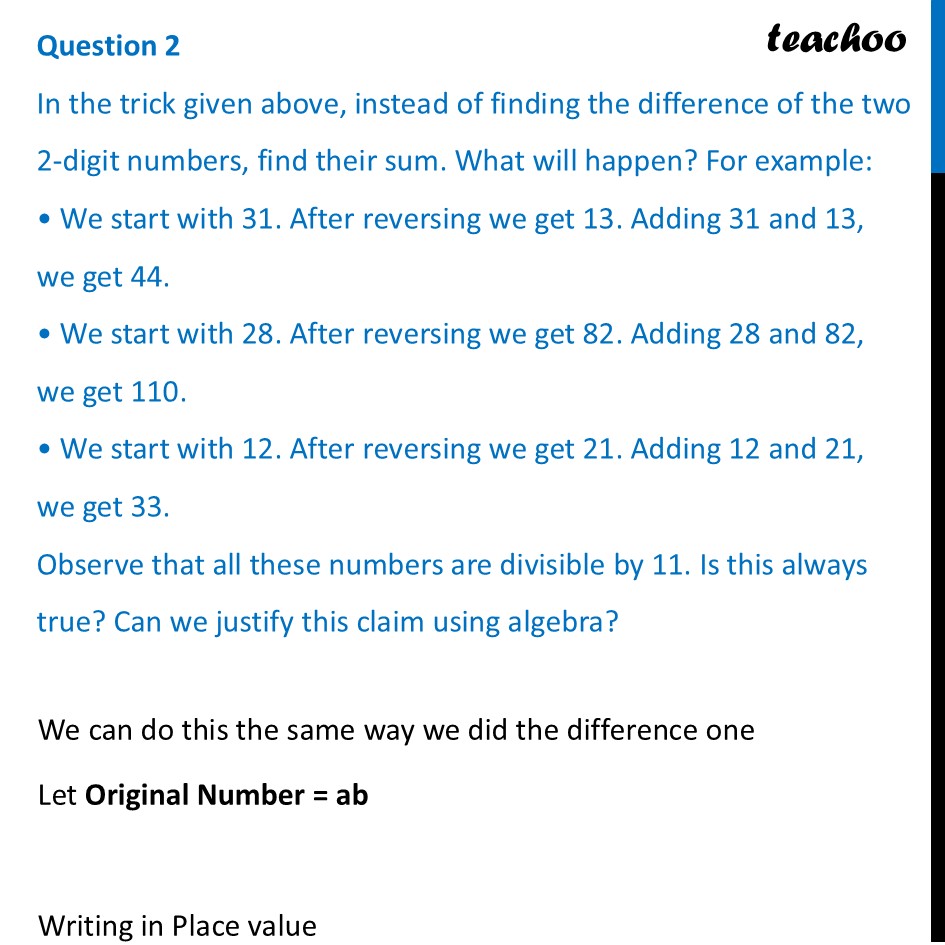
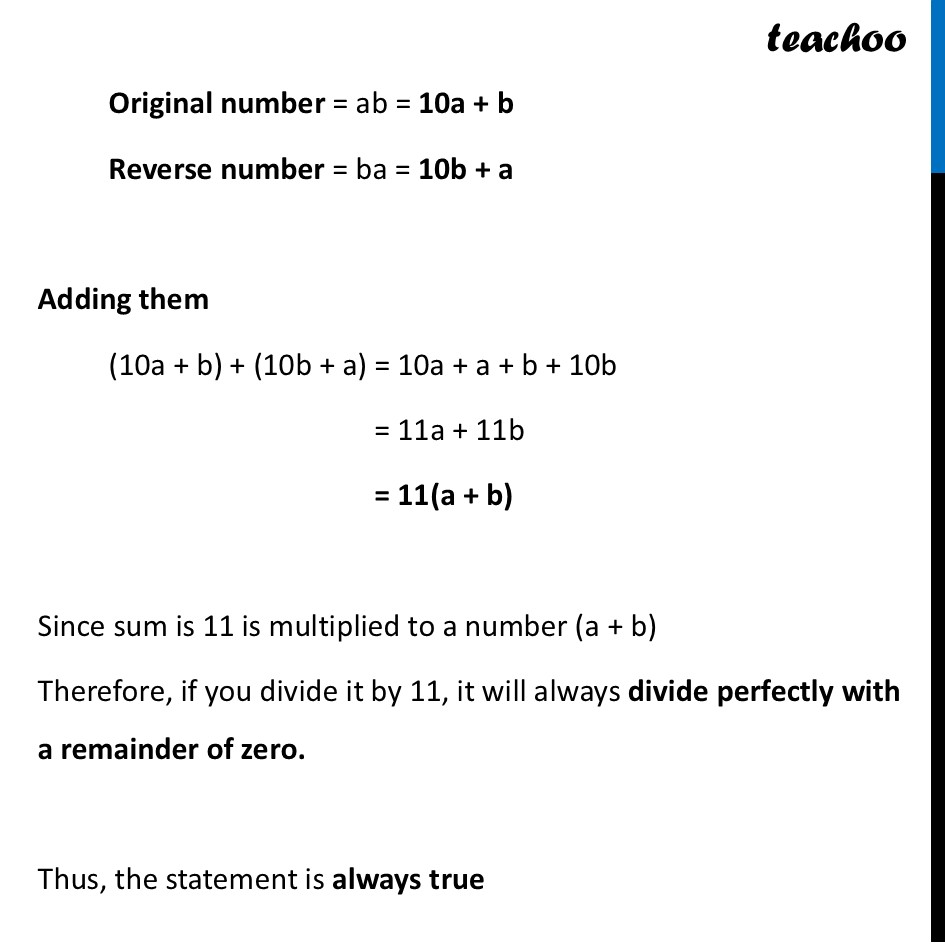
Figure it out - Page 145-147
Last updated at March 6, 2026 by Teachoo
Transcript
Question 2 In the trick given above, instead of finding the difference of the two 2-digit numbers, find their sum. What will happen? For example: • We start with 31. After reversing we get 13. Adding 31 and 13, we get 44. • We start with 28. After reversing we get 82. Adding 28 and 82, we get 110. • We start with 12. After reversing we get 21. Adding 12 and 21, we get 33. Observe that all these numbers are divisible by 11. Is this always true? Can we justify this claim using algebra?We can do this the same way we did the difference one Let Original Number = ab Writing in Place value Original number = ab = 10a + b Reverse number = ba = 10b + a Adding them (10a + b) + (10b + a) = 10a + a + b + 10b = 11a + 11b = 11(a + b) Since sum is 11 is multiplied to a number (a + b) Therefore, if you divide it by 11, it will always divide perfectly with a remainder of zero. Thus, the statement is always true
