
 You are here
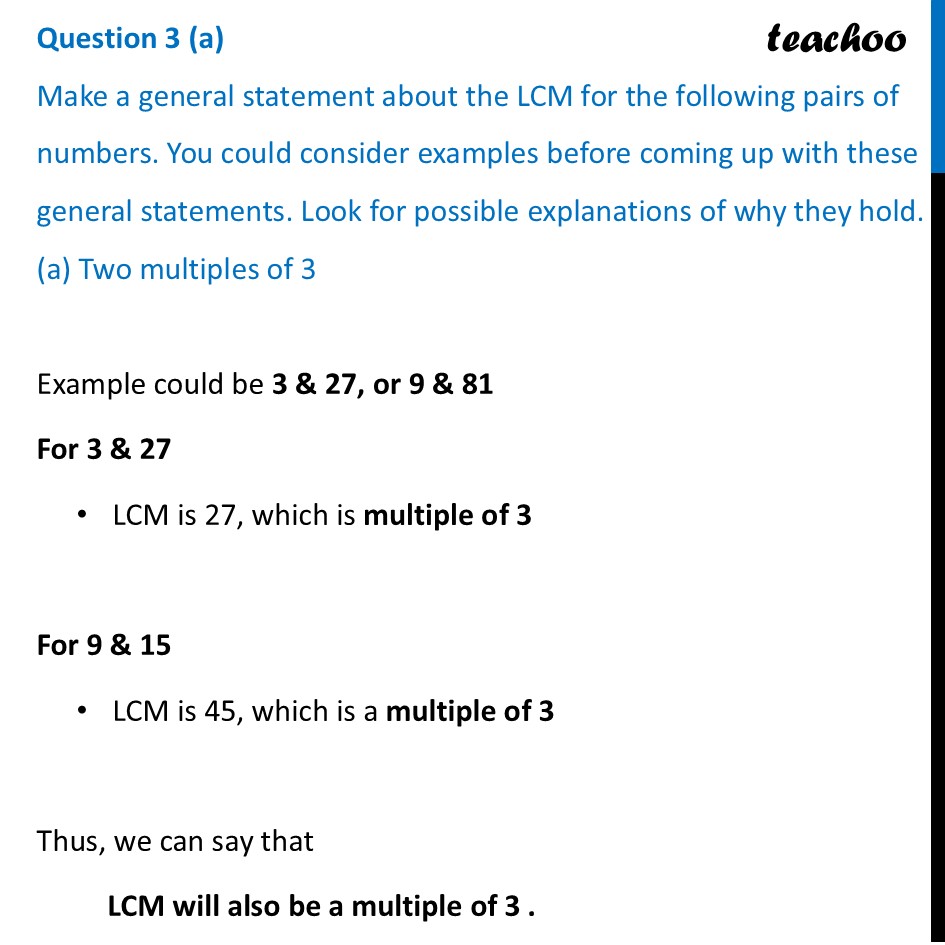
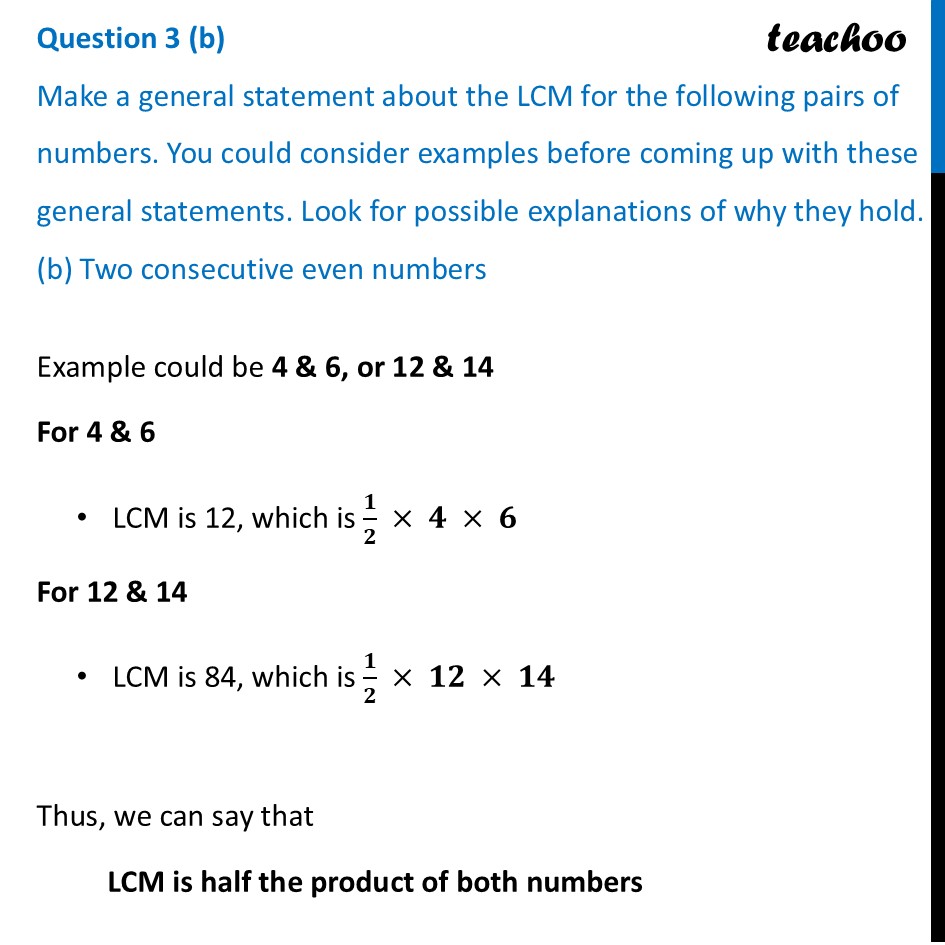
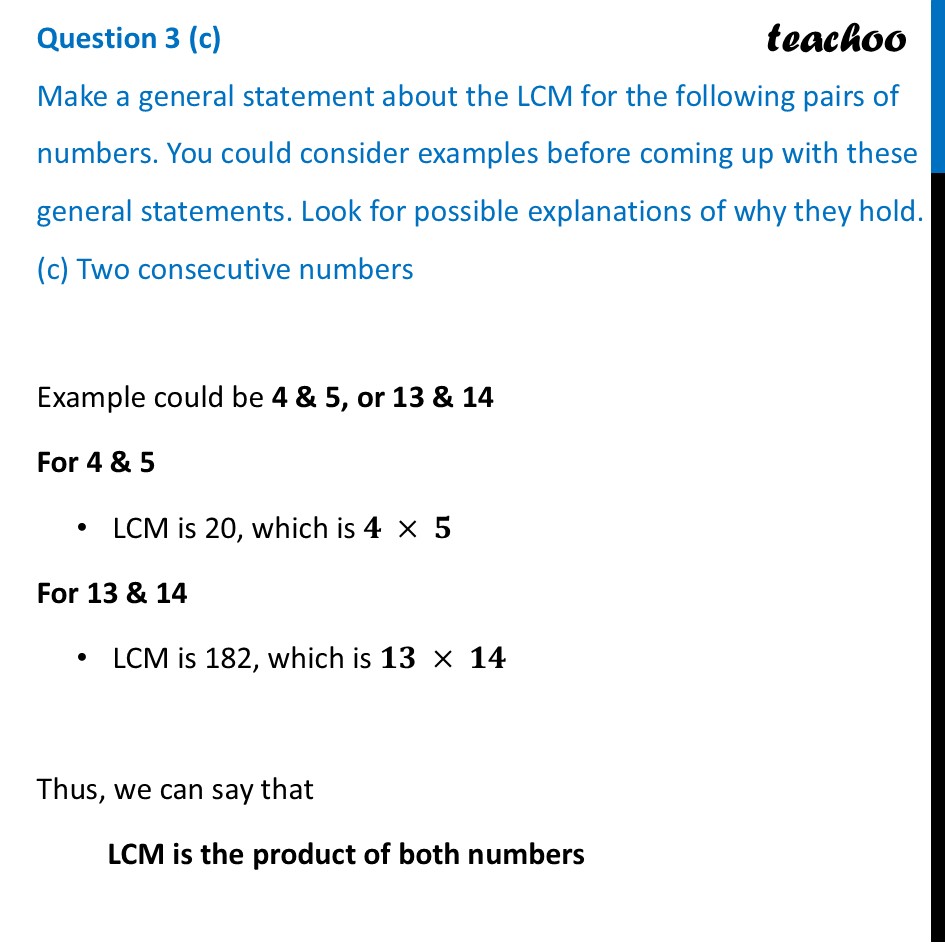
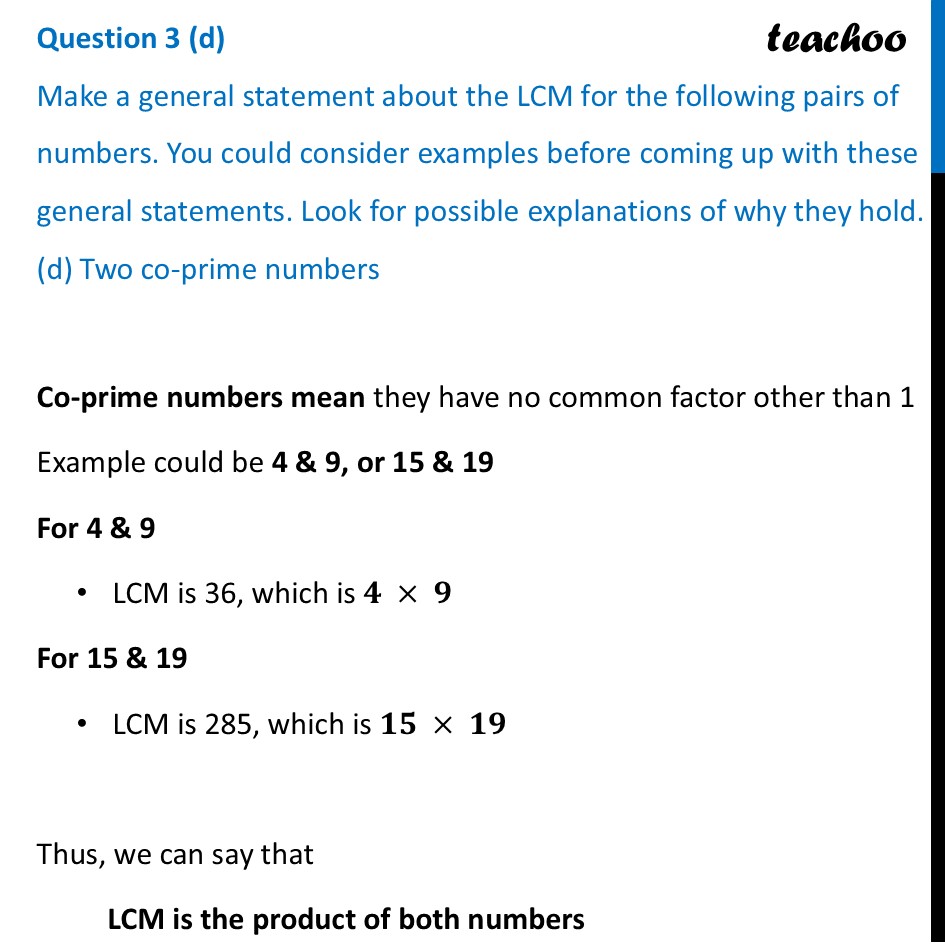
Figure it out - Page 59
Figure it out - Page 59
Last updated at January 23, 2026 by Teachoo
Transcript
Question 3 (a) Make a general statement about the LCM for the following pairs of numbers. You could consider examples before coming up with these general statements. Look for possible explanations of why they hold. (a) Two multiples of 3Example could be 3 & 27, or 9 & 81 For 3 & 27 LCM is 27, which is multiple of 3 For 9 & 15 LCM is 45, which is a multiple of 3 Thus, we can say that LCM will also be a multiple of 3 . Question 3 (b) Make a general statement about the LCM for the following pairs of numbers. You could consider examples before coming up with these general statements. Look for possible explanations of why they hold. (b) Two consecutive even numbersExample could be 4 & 6, or 12 & 14 For 4 & 6 LCM is 12, which is 𝟏/𝟐 × 𝟒 × 𝟔 For 12 & 14 LCM is 84, which is 𝟏/𝟐 × 𝟏𝟐 × 𝟏𝟒 Thus, we can say that LCM is half the product of both numbers Question 3 (c) Make a general statement about the LCM for the following pairs of numbers. You could consider examples before coming up with these general statements. Look for possible explanations of why they hold. (c) Two consecutive numbers Example could be 4 & 5, or 13 & 14 For 4 & 5 LCM is 20, which is 𝟒 × 𝟓 For 13 & 14 LCM is 182, which is 𝟏𝟑 × 𝟏𝟒 Thus, we can say that LCM is the product of both numbers Question 3 (d) Make a general statement about the LCM for the following pairs of numbers. You could consider examples before coming up with these general statements. Look for possible explanations of why they hold. (d) Two co-prime numbersCo-prime numbers mean they have no common factor other than 1 Example could be 4 & 9, or 15 & 19 For 4 & 9 LCM is 36, which is 𝟒 × 𝟗 For 15 & 19 LCM is 285, which is 𝟏𝟓 × 𝟏𝟗 Thus, we can say that LCM is the product of both numbers
