 You are here

![Lowest Common Multiple (LCM) - Explained [Class 7 Ganita Prakash] - Least, but not Last!](https://cdn.teachoo.com/f06902ce-f49b-45b9-9667-3dba15a1eee8/slide3.jpg)
Least, but not Last!
Last updated at January 23, 2026 by Teachoo
Transcript
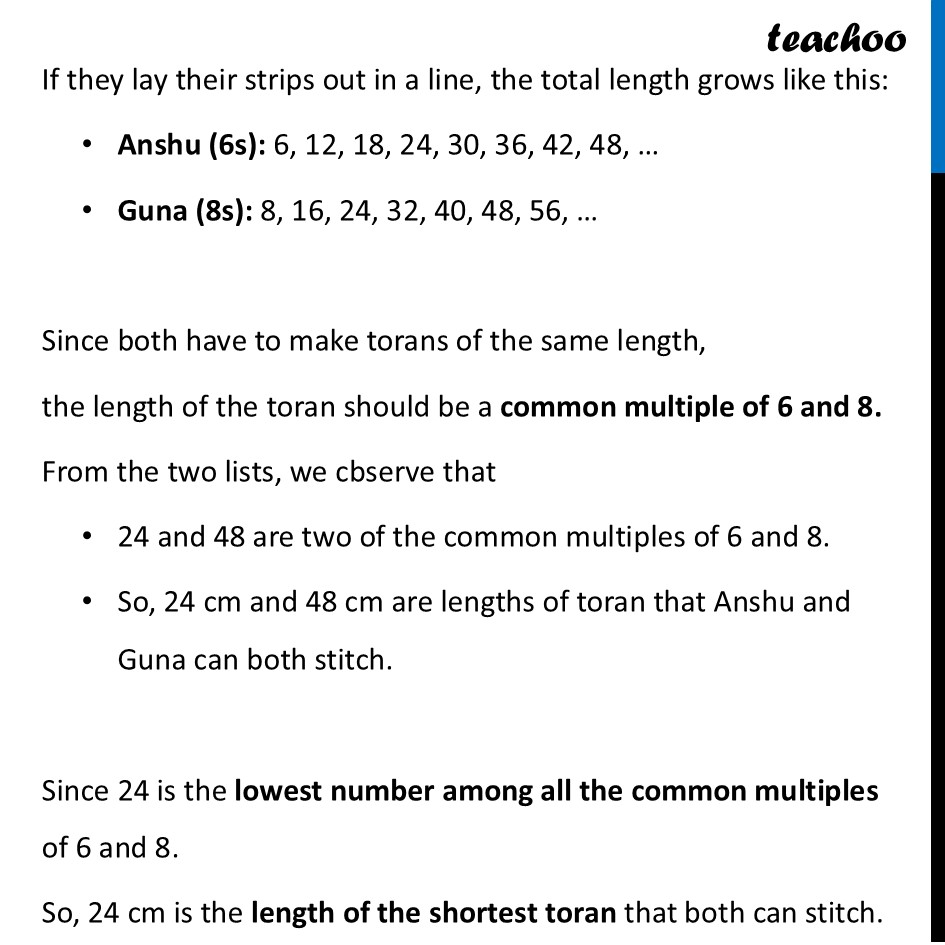
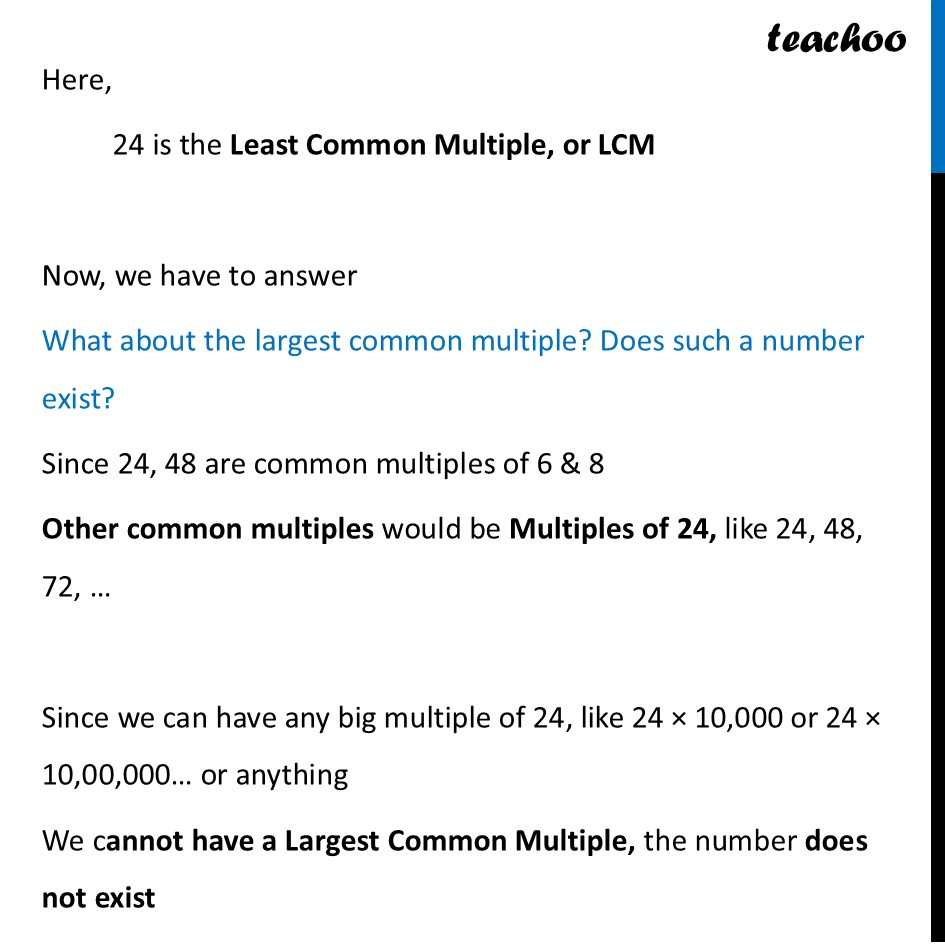
Lowest Common Multiple (LCM)We start with a question Anshu and Guna make torans out of strips of cloth. Multiple strips are placed one next to another to make a toran. Anshu uses strips of length 6 cm and Guna uses strips of 8 cm length. If both have to make torans of the same length, what is the smallest possible length, the torans could be? What is the length of the shortest toran that they can both make? Given that Anshu and Guna, making decorative strips (torans). Anshu has strips that are 6 cm long. Guna has strips that are 8 cm long. If they lay their strips out in a line, the total length grows like this: Anshu (6s): 6, 12, 18, 24, 30, 36, 42, 48, … Guna (8s): 8, 16, 24, 32, 40, 48, 56, … Since both have to make torans of the same length, the length of the toran should be a common multiple of 6 and 8. From the two lists, we cbserve that 24 and 48 are two of the common multiples of 6 and 8. So, 24 cm and 48 cm are lengths of toran that Anshu and Guna can both stitch. Since 24 is the lowest number among all the common multiples of 6 and 8. So, 24 cm is the length of the shortest toran that both can stitch. Here, 24 is the Least Common Multiple, or LCM Now, we have to answer What about the largest common multiple? Does such a number exist? Since 24, 48 are common multiples of 6 & 8 Other common multiples would be Multiples of 24, like 24, 48, 72, … Since we can have any big multiple of 24, like 24 × 10,000 or 24 × 10,00,000… or anything We cannot have a Largest Common Multiple, the number does not exist
