![[Class 7] Do larger numbers have more prime factors than smaller ones? - Prime Factorisation](https://cdn.teachoo.com/13f7eaae-072e-4917-8c67-267684c39581/slide52.jpg)
Prime Factorisation

 You are here
Prime Factorisation
Last updated at January 22, 2026 by Teachoo
Transcript
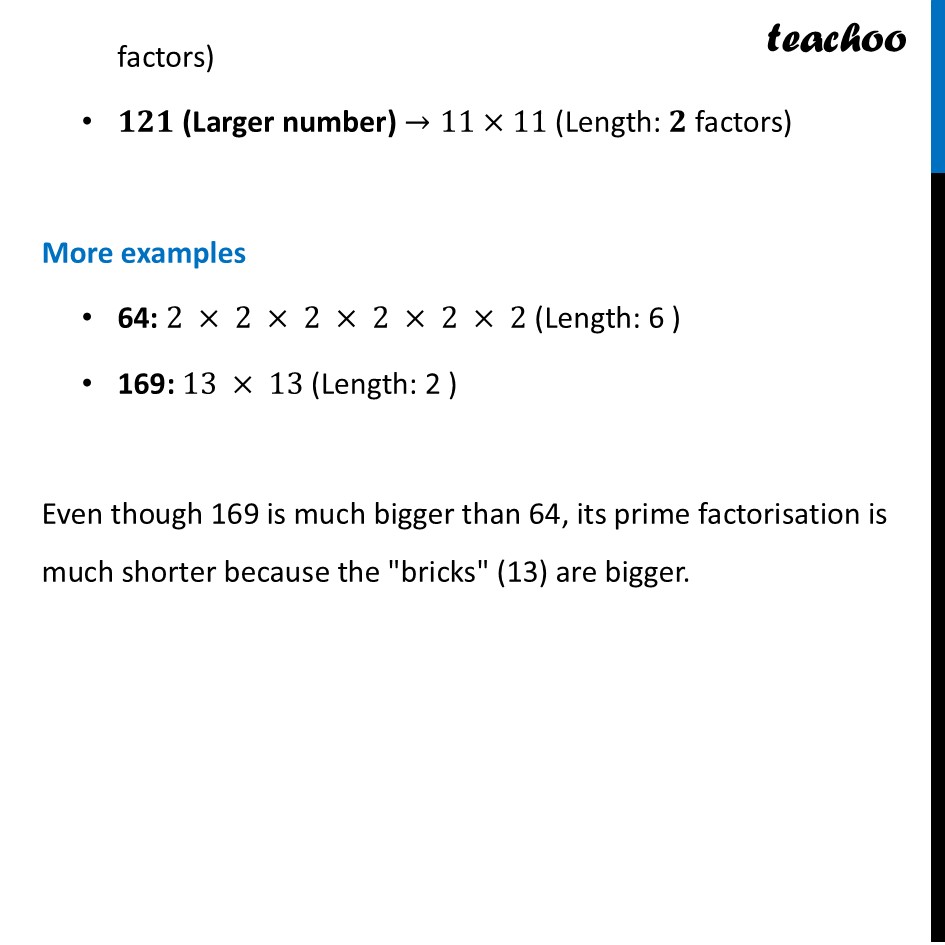
Do larger numbers have more prime factors than smaller ones?No, they do not Explanation: The length of a prime factorisation depends on how small the prime factors are, not just how big the total number is. If a number is built from tiny bricks (like 2s), you need a LOT of them, so the chain is long. If a number is built from huge bricks (like 11s, 13s, or bigger), you only need a few, so the chain is short. Examples 96 (Smaller number) →2 × 2 × 2 × 2 × 2 × 3 (Length: 6 factors) 𝟏𝟐𝟏 (Larger number) →11×11 (Length: 𝟐 factors) More examples 64: 2 × 2 × 2 × 2 × 2 × 2 (Length: 6 ) 169: 13 × 13 (Length: 2 ) Even though 169 is much bigger than 64, its prime factorisation is much shorter because the "bricks" (13) are bigger.
