You are here
Virahāṅka Fibonacci Numbers
Last updated at October 17, 2025 by Teachoo
Transcript
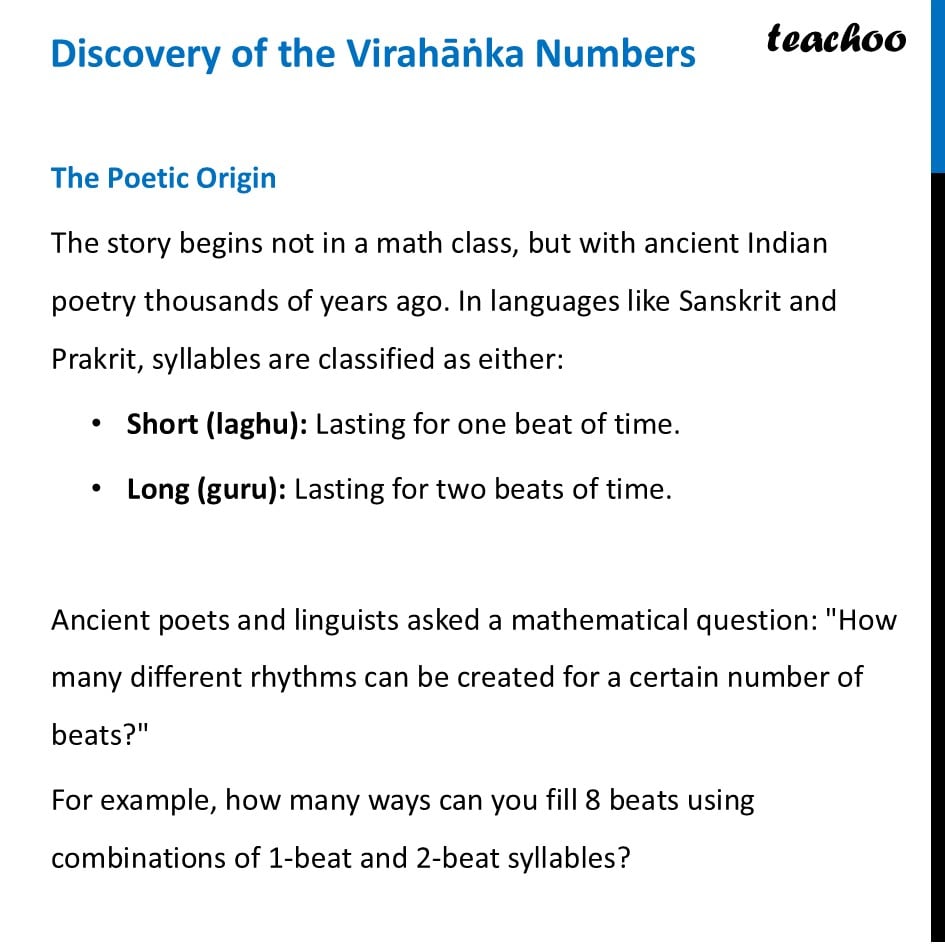
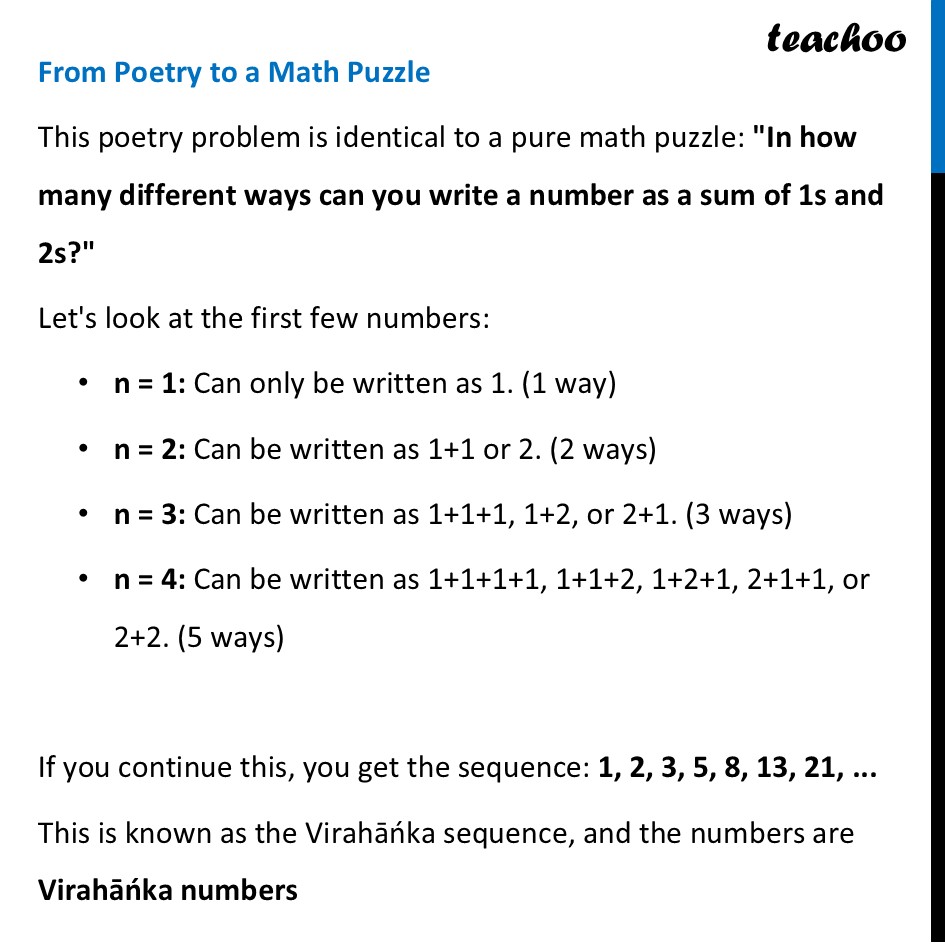
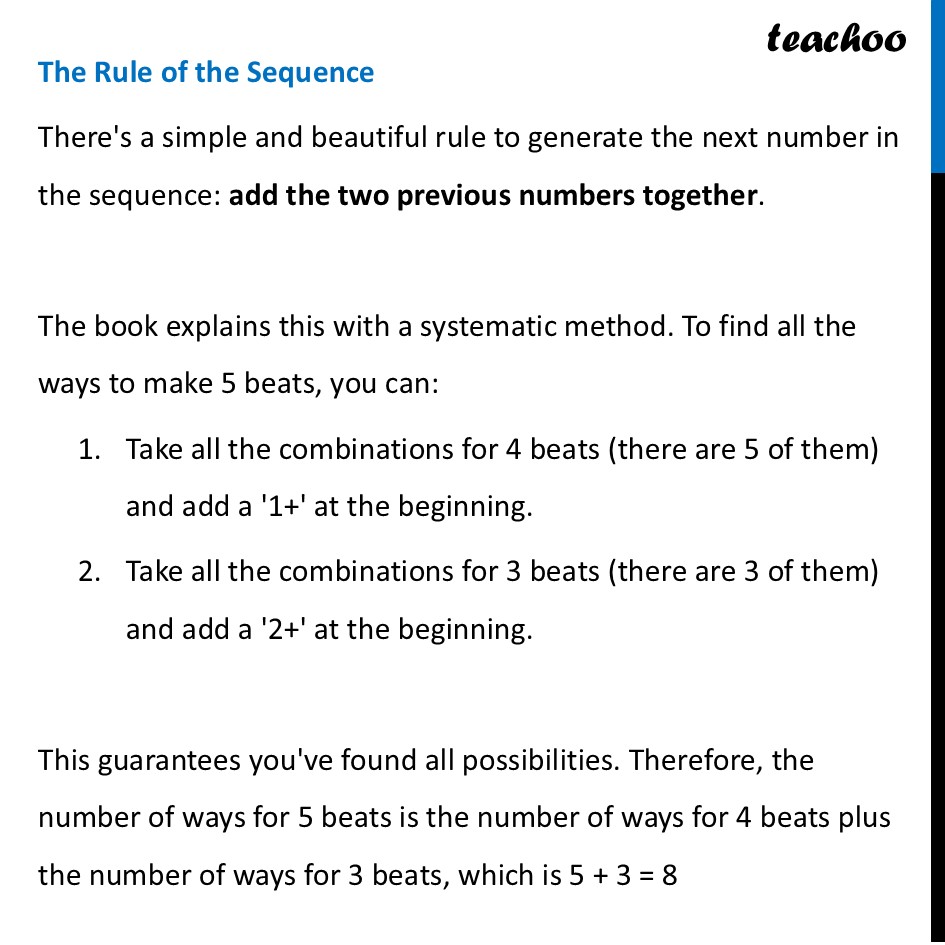
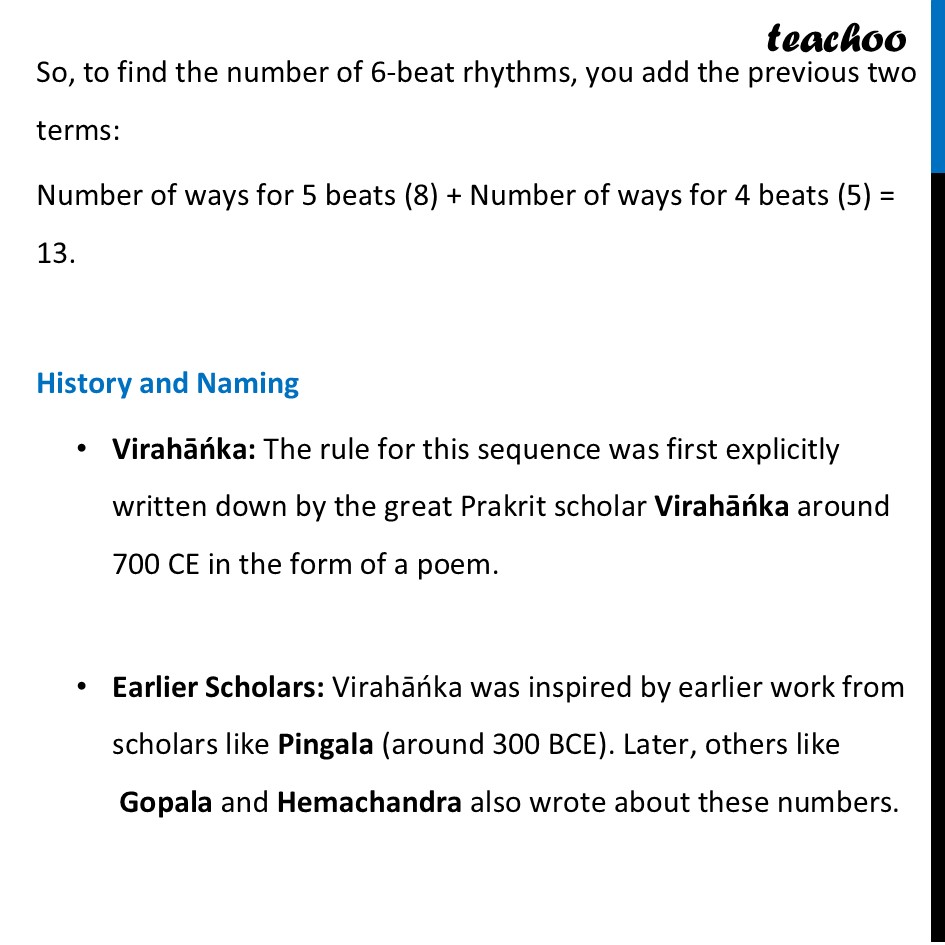
Discovery of the Virahāṅka Numbers The Poetic Origin The story begins not in a math class, but with ancient Indian poetry thousands of years ago. In languages like Sanskrit and Prakrit, syllables are classified as either: Short (laghu): Lasting for one beat of time. Long (guru): Lasting for two beats of time. Ancient poets and linguists asked a mathematical question: "How many different rhythms can be created for a certain number of beats?" For example, how many ways can you fill 8 beats using combinations of 1-beat and 2-beat syllables? From Poetry to a Math Puzzle This poetry problem is identical to a pure math puzzle: "In how many different ways can you write a number as a sum of 1s and 2s?" Let's look at the first few numbers: n = 1: Can only be written as 1. (1 way) n = 2: Can be written as 1+1 or 2. (2 ways) n = 3: Can be written as 1+1+1, 1+2, or 2+1. (3 ways) n = 4: Can be written as 1+1+1+1, 1+1+2, 1+2+1, 2+1+1, or 2+2. (5 ways) If you continue this, you get the sequence: 1, 2, 3, 5, 8, 13, 21, ... This is known as the Virahāńka sequence, and the numbers are Virahāńka numbers. The Rule of the Sequence There's a simple and beautiful rule to generate the next number in the sequence: add the two previous numbers together. The book explains this with a systematic method. To find all the ways to make 5 beats, you can: Take all the combinations for 4 beats (there are 5 of them) and add a '1+' at the beginning. Take all the combinations for 3 beats (there are 3 of them) and add a '2+' at the beginning. This guarantees you've found all possibilities. Therefore, the number of ways for 5 beats is the number of ways for 4 beats plus the number of ways for 3 beats, which is $5 + 3 = 8$. So, to find the number of 6-beat rhythms, you add the previous two terms: Number of ways for 5 beats (8) + Number of ways for 4 beats (5) = 13. History and Naming Virahāńka: The rule for this sequence was first explicitly written down by the great Prakrit scholar Virahāńka around 700 CE in the form of a poem. Earlier Scholars: Virahāńka was inspired by earlier work from scholars like Pingala (around 300 BCE). Later, others like Gopala and Hemachandra also wrote about these numbers. Fibonacci: In the West, these numbers became known as the Fibonacci numbers, named after an Italian mathematician who wrote about them in 1202 CE—about 500 years after Virahāńka. Because Fibonacci was not the first, second, or even third person to describe them, the term "Virahāńka-Fibonacci numbers" is sometimes used to be historically accurate. From Poetry to a Math Puzzle This poetry problem is identical to a pure math puzzle: "In how many different ways can you write a number as a sum of 1s and 2s?" Let's look at the first few numbers: n = 1: Can only be written as 1. (1 way) n = 2: Can be written as 1+1 or 2. (2 ways) n = 3: Can be written as 1+1+1, 1+2, or 2+1. (3 ways) n = 4: Can be written as 1+1+1+1, 1+1+2, 1+2+1, 2+1+1, or 2+2. (5 ways) If you continue this, you get the sequence: 1, 2, 3, 5, 8, 13, 21, ... This is known as the Virahāńka sequence, and the numbers are Virahāńka numbers The Rule of the Sequence There's a simple and beautiful rule to generate the next number in the sequence: add the two previous numbers together. The book explains this with a systematic method. To find all the ways to make 5 beats, you can: Take all the combinations for 4 beats (there are 5 of them) and add a '1+' at the beginning. Take all the combinations for 3 beats (there are 3 of them) and add a '2+' at the beginning. This guarantees you've found all possibilities. Therefore, the number of ways for 5 beats is the number of ways for 4 beats plus the number of ways for 3 beats, which is 5 + 3 = 8 So, to find the number of 6-beat rhythms, you add the previous two terms: Number of ways for 5 beats (8) + Number of ways for 4 beats (5) = 13. History and Naming Virahāńka: The rule for this sequence was first explicitly written down by the great Prakrit scholar Virahāńka around 700 CE in the form of a poem. Earlier Scholars: Virahāńka was inspired by earlier work from scholars like Pingala (around 300 BCE). Later, others like Gopala and Hemachandra also wrote about these numbers. Fibonacci: In the West, these numbers became known as the Fibonacci numbers, named after an Italian mathematician who wrote about them in 1202 CE—about 500 years after Virahāńka. Because Fibonacci was not the first, second, or even third person to describe them, the term "Virahāńka-Fibonacci numbers" is sometimes used to be historically accurate. So, to find the number of 6-beat rhythms, you add the previous two terms: Number of ways for 5 beats (8) + Number of ways for 4 beats (5) = 13. History and Naming Virahāńka: The rule for this sequence was first explicitly written down by the great Prakrit scholar Virahāńka around 700 CE in the form of a poem. Earlier Scholars: Virahāńka was inspired by earlier work from scholars like Pingala (around 300 BCE). Later, others like Gopala and Hemachandra also wrote about these numbers. Fibonacci: In the West, these numbers became known as the Fibonacci numbers, named after an Italian mathematician who wrote about them in 1202 CE—about 500 years after Virahāńka. Because Fibonacci was not the first, second, or even third person to describe them, the term "Virahāńka-Fibonacci numbers" is sometimes used to be historically accurate.