
 You are here
![[Class 6 Curiosity] Summary of Different Methods - Chapter 9 Science - Concepts](https://cdn.teachoo.com/554d4d47-f7fb-4711-a495-72554a9e3619/slide62.jpg)
Last updated at January 16, 2026 by Teachoo
Transcript
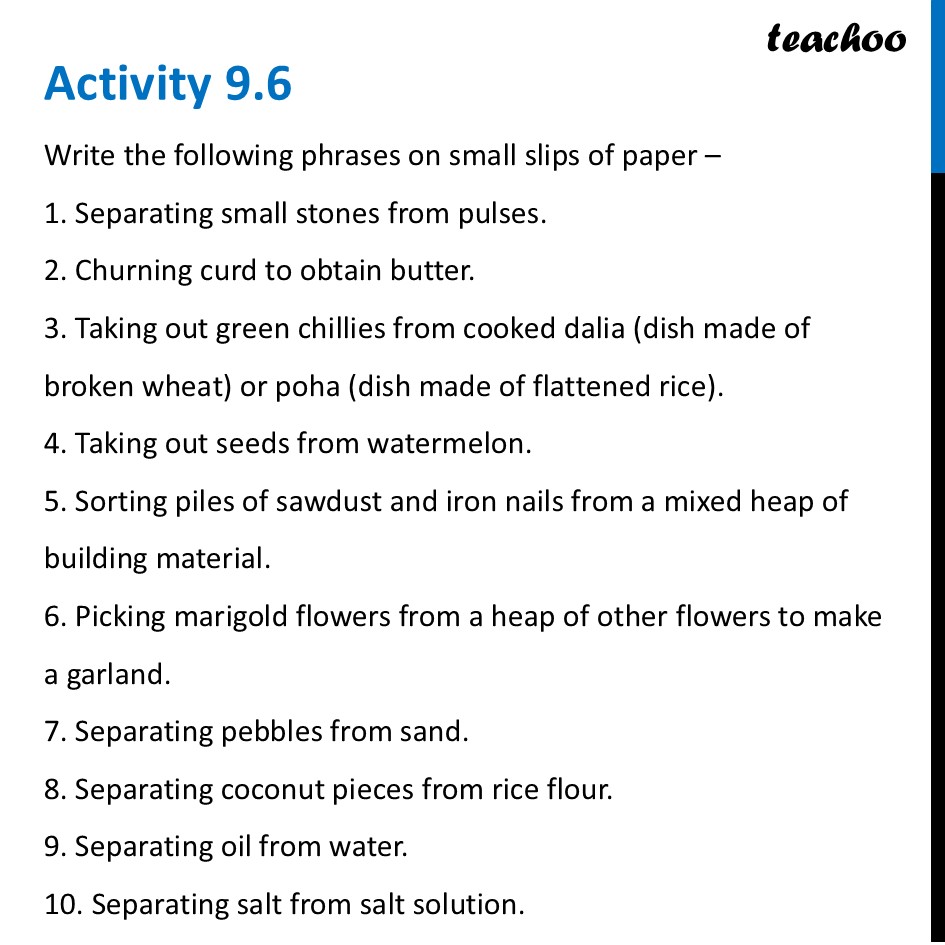
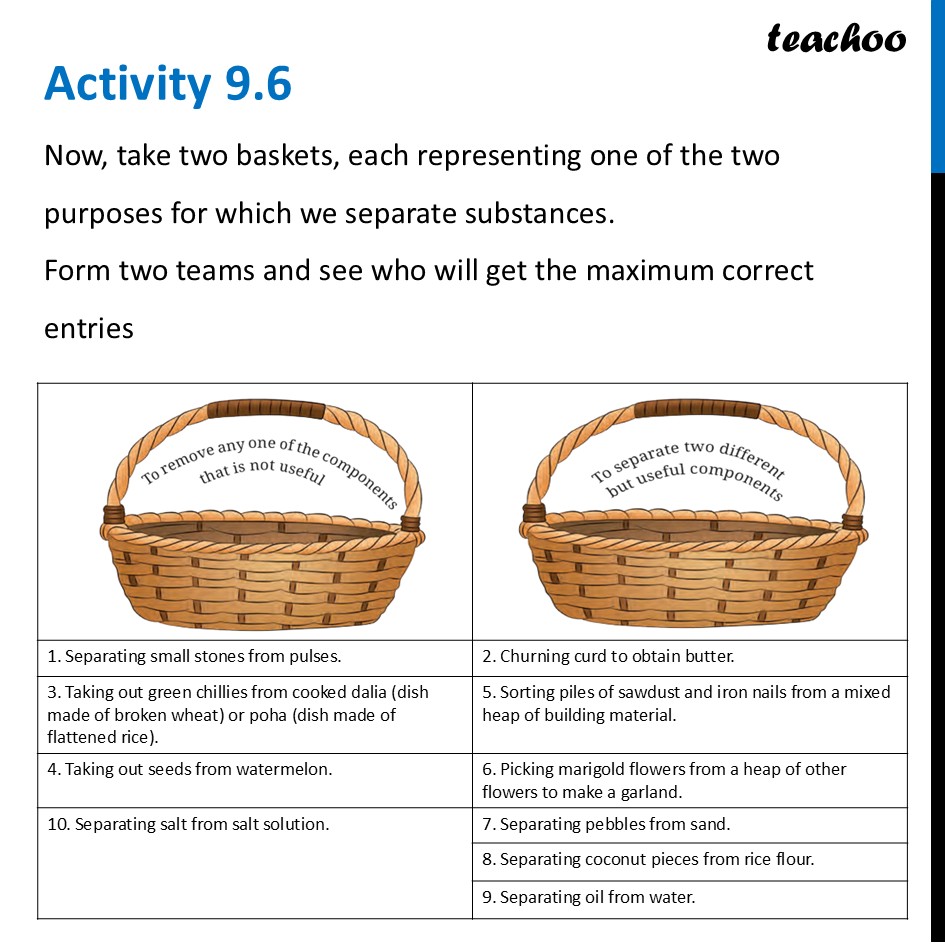
Summary of Different Methods of SeparationMethod When it is Used Threshing When grains need to be separated from harvested stalks (e.g., wheat grains from wheat plants). Winnowing When lighter husk/chaff has to be separated from heavier grains using air or wind. Sieving When components have different particle sizes and the solid impurities are bigger than useful material (e.g., stones from flour). Evaporation When a dissolved solid needs to be separated from a liquid (e.g., salt from saltwater). Sedimentation When heavy insoluble solids are mixed with a liquid and are allowed to settle at the bottom (e.g., sand in water). Decantation When the clear liquid has to be carefully poured off after sedimentation, without disturbing the settled solid. Filtration When insoluble solid particles are mixed with a liquid and the particles are larger than filter pores (e.g., tea leaves from tea). Churning When butter (fat) is separated from curd by rotating/stirring. Magnetic Separation When one component is magnetic and the other is nonmagnetic (e.g., iron scrap from waste).Activity 9.6Write the following phrases on small slips of paper – 1. Separating small stones from pulses. 2. Churning curd to obtain butter. 3. Taking out green chillies from cooked dalia (dish made of broken wheat) or poha (dish made of flattened rice). 4. Taking out seeds from watermelon. 5. Sorting piles of sawdust and iron nails from a mixed heap of building material. 6. Picking marigold flowers from a heap of other flowers to make a garland. 7. Separating pebbles from sand. 8. Separating coconut pieces from rice flour. 9. Separating oil from water. 10. Separating salt from salt solution. Activity 9.6Now, take two baskets, each representing one of the two purposes for which we separate substances. Form two teams and see who will get the maximum correct entries 1. Separating small stones from pulses. 2. Churning curd to obtain butter. 3. Taking out green chillies from cooked dalia (dish made of broken wheat) or poha (dish made of flattened rice). 5. Sorting piles of sawdust and iron nails from a mixed heap of building material. 4. Taking out seeds from watermelon. 6. Picking marigold flowers from a heap of other flowers to make a garland. 10. Separating salt from salt solution. 7. Separating pebbles from sand. 8. Separating coconut pieces from rice flour. 9. Separating oil from water.
