
 You are here
Sharing, but Not Equally!
Sharing, but Not Equally!
Last updated at January 15, 2026 by Teachoo
Transcript
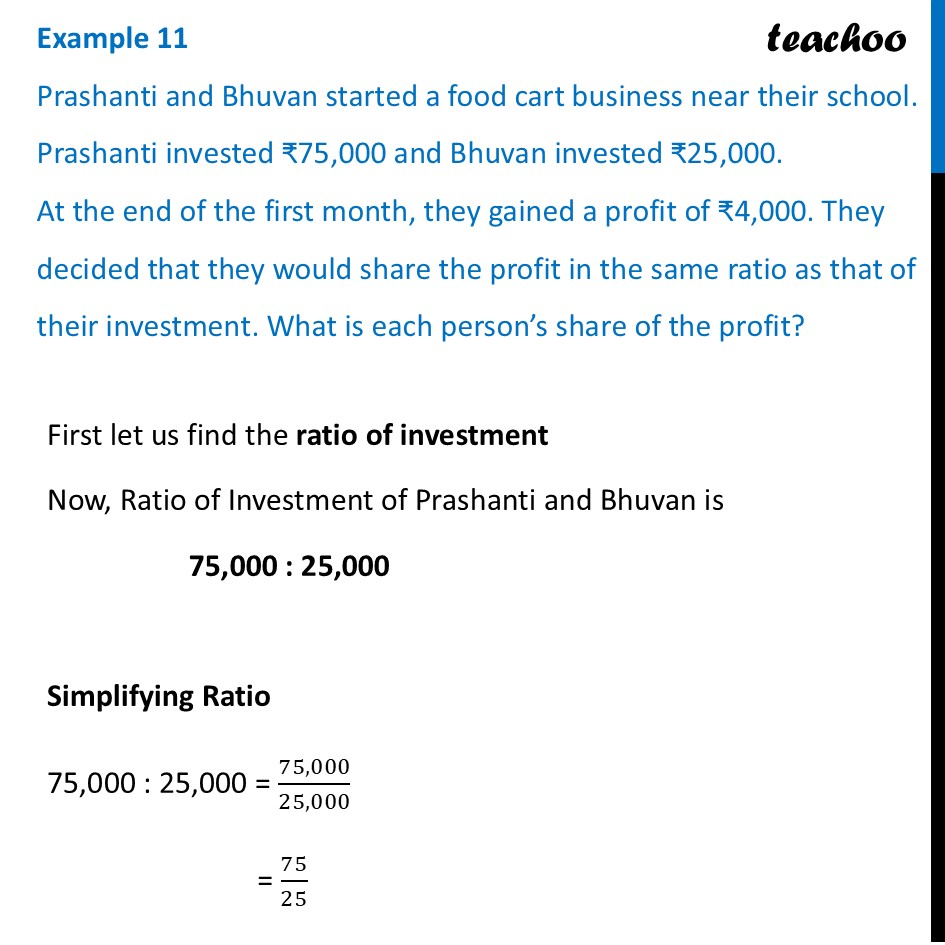
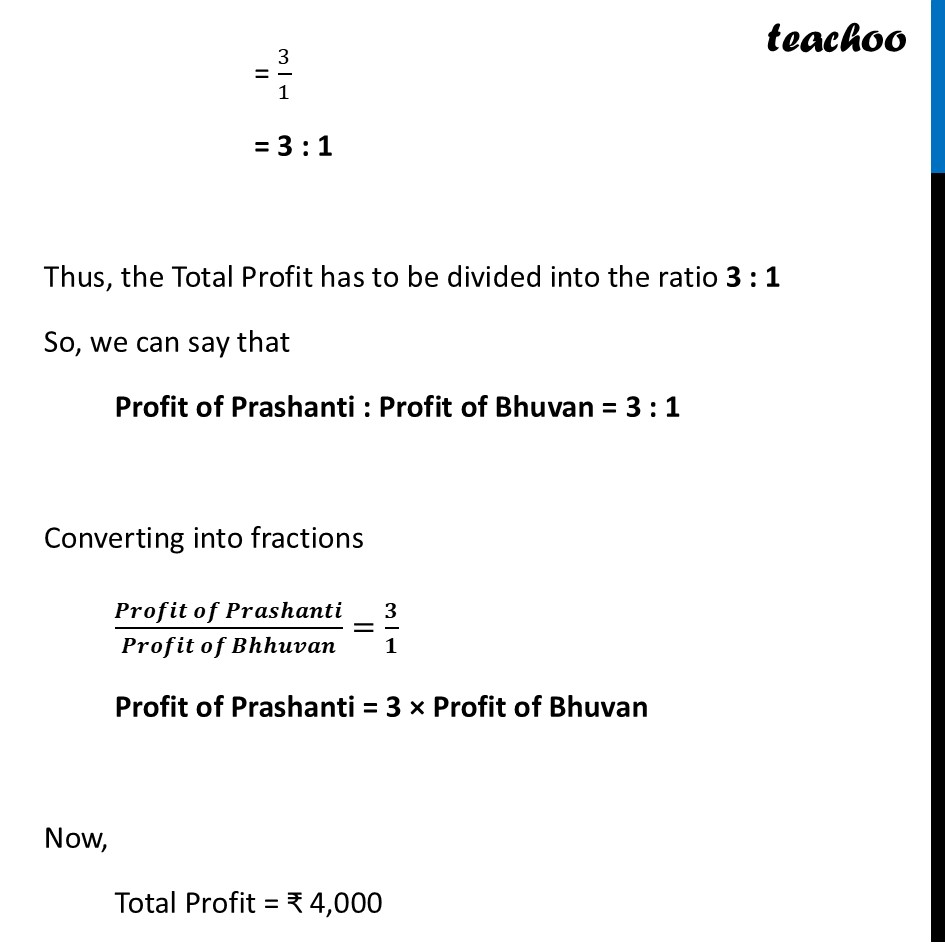
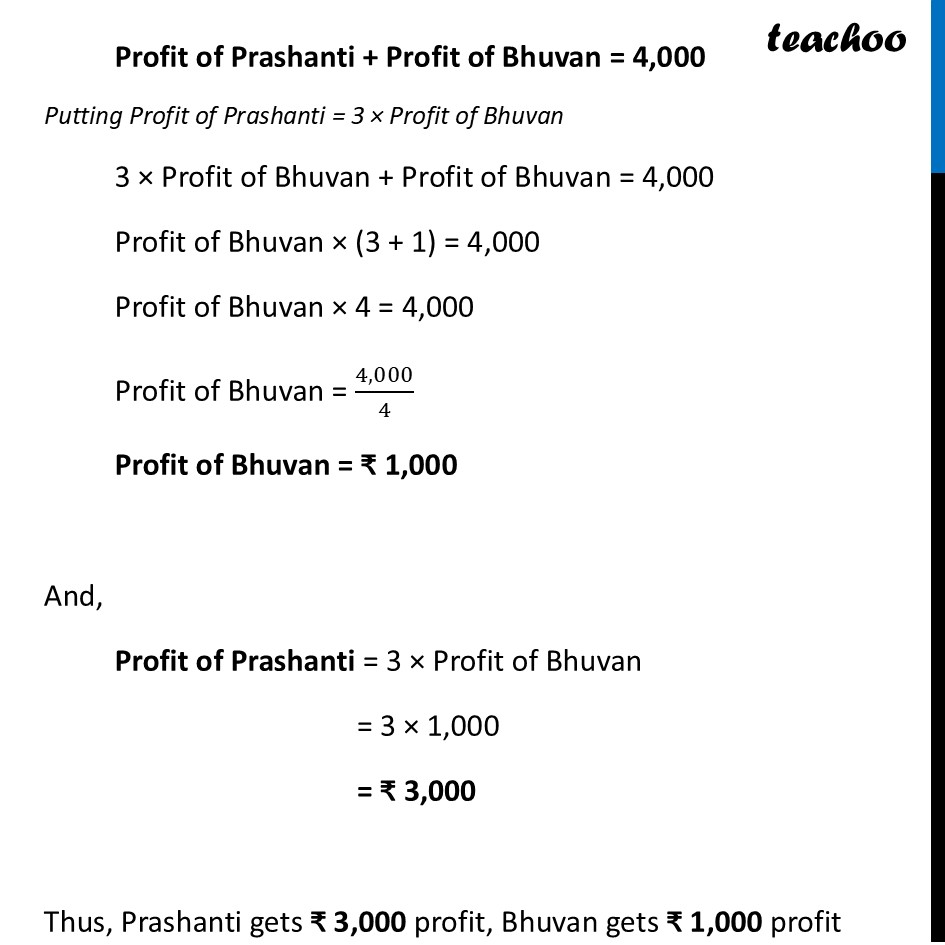
Example 11 Prashanti and Bhuvan started a food cart business near their school. Prashanti invested ₹75,000 and Bhuvan invested ₹25,000. At the end of the first month, they gained a profit of ₹4,000. They decided that they would share the profit in the same ratio as that of their investment. What is each person’s share of the profit?First let us find the ratio of investment Now, Ratio of Investment of Prashanti and Bhuvan is 75,000 : 25,000 Simplifying Ratio 75,000 : 25,000 = 75,000/25,000 = 75/25 = 3/1 = 3 : 1 Thus, the Total Profit has to be divided into the ratio 3 : 1 So, we can say that Profit of Prashanti : Profit of Bhuvan = 3 : 1 Converting into fractions (𝑷𝒓𝒐𝒇𝒊𝒕 𝒐𝒇 𝑷𝒓𝒂𝒔𝒉𝒂𝒏𝒕𝒊)/(𝑷𝒓𝒐𝒇𝒊𝒕 𝒐𝒇 𝑩𝒉𝒉𝒖𝒗𝒂𝒏)=𝟑/𝟏 Profit of Prashanti = 3 × Profit of Bhuvan Now, Total Profit = ₹ 4,000 Profit of Prashanti + Profit of Bhuvan = 4,000 Putting Profit of Prashanti = 3 × Profit of Bhuvan 3 × Profit of Bhuvan + Profit of Bhuvan = 4,000 Profit of Bhuvan × (3 + 1) = 4,000 Profit of Bhuvan × 4 = 4,000 Profit of Bhuvan = 4,000/4 Profit of Bhuvan = ₹ 1,000 And, Profit of Prashanti = 3 × Profit of Bhuvan = 3 × 1,000 = ₹ 3,000 Thus, Prashanti gets ₹ 3,000 profit, Bhuvan gets ₹ 1,000 profit
