
 You are here
![[Activity 2] Go to the market and collect the prices of different size - Acitvity and Question - Page 171](https://cdn.teachoo.com/47b5a96d-6813-46ab-8f17-9e6edfea2a8b/slide96.jpg)

Acitvity and Question - Page 171
Acitvity and Question - Page 171
Last updated at January 15, 2026 by Teachoo
Transcript
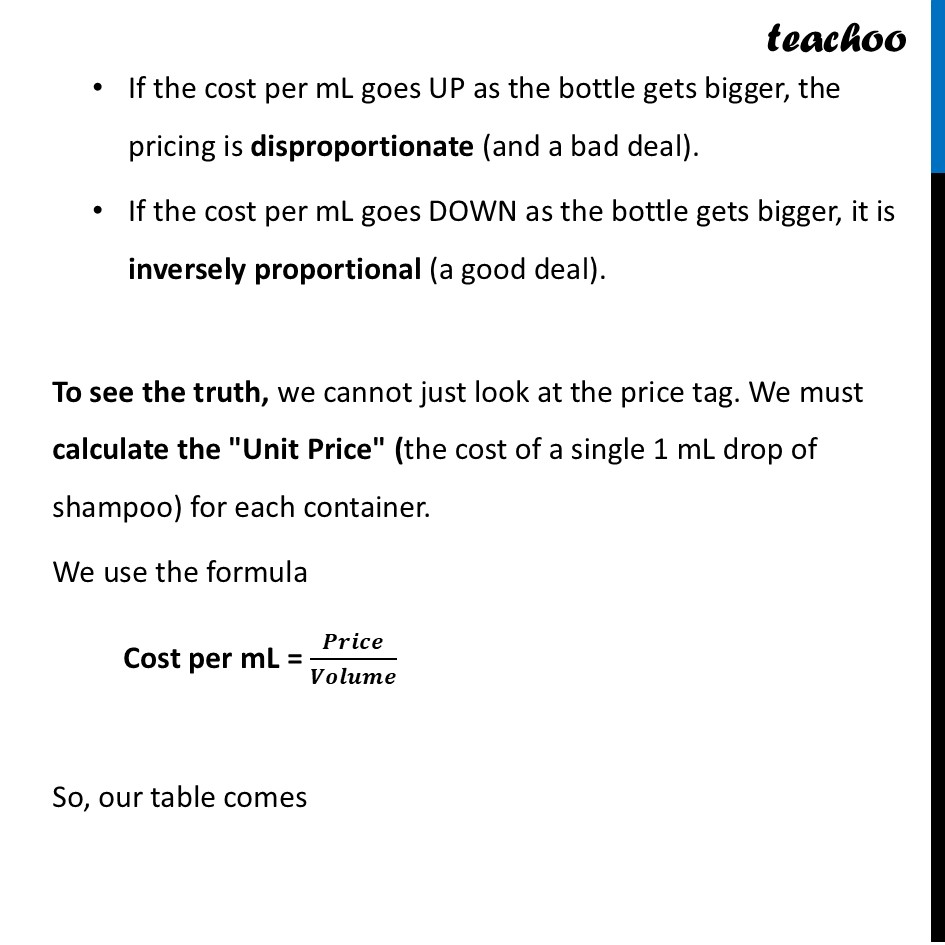
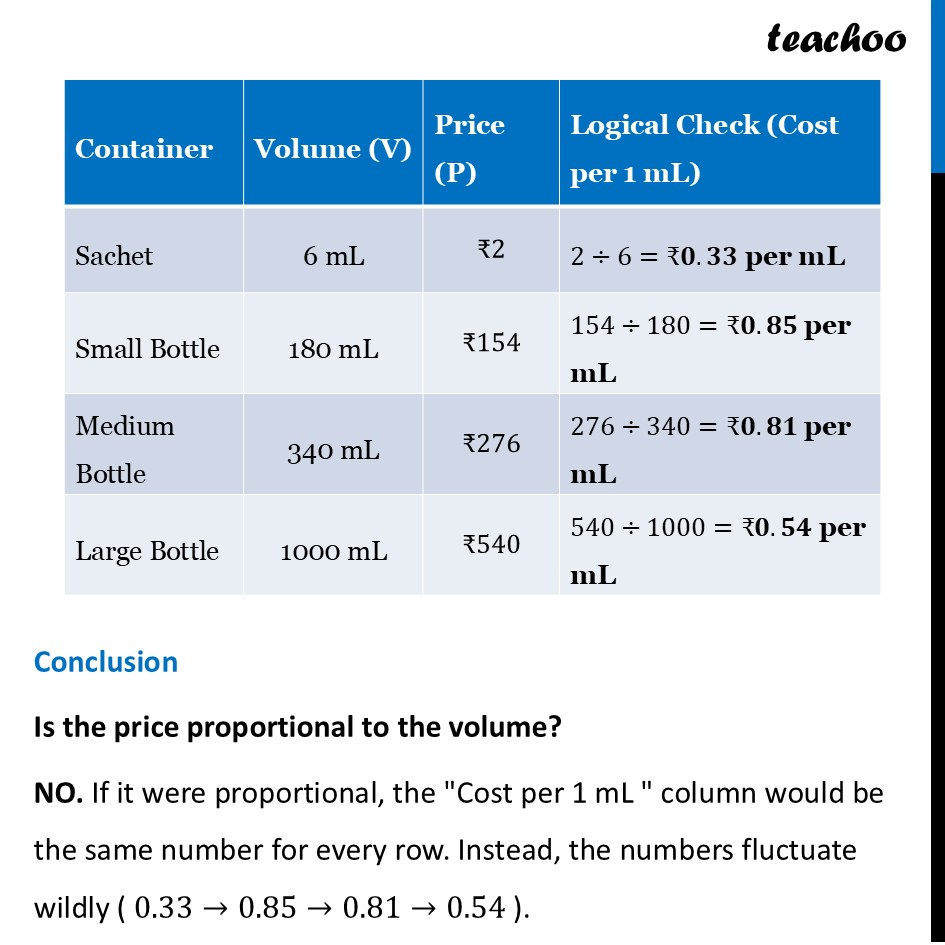
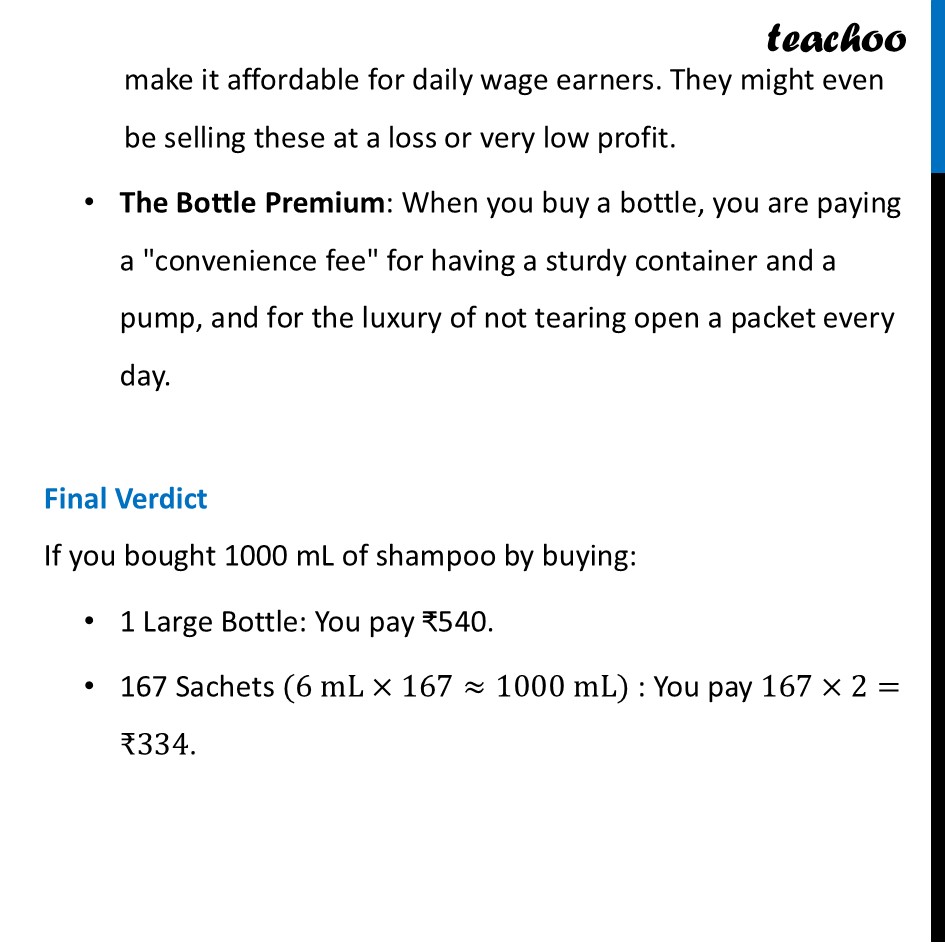
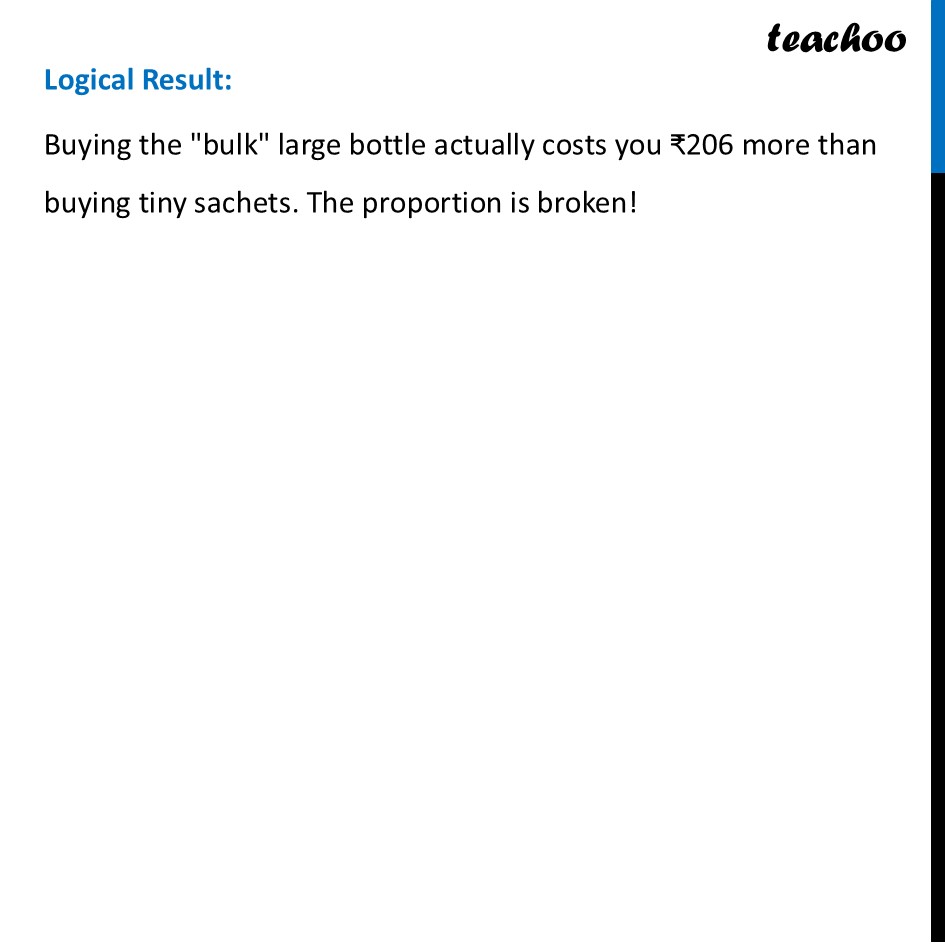
Activity 2 Go to the market and collect the prices of different sizes of shampoo containers of the same shampoo and create a table like the one given below. See if the volume of shampoo is proportional to the price.In a fair market, if you buy more of something, the price usually drops per unit (bulk discount). Therefore, if the pricing were perfectly proportional, the cost per milliliter ( 𝒎𝑳 ) should stay exactly the same regardless of the bottle size. If the cost per mL goes UP as the bottle gets bigger, the pricing is disproportionate (and a bad deal). If the cost per mL goes DOWN as the bottle gets bigger, it is inversely proportional (a good deal). To see the truth, we cannot just look at the price tag. We must calculate the "Unit Price" (the cost of a single 1 mL drop of shampoo) for each container. We use the formula Cost per mL = 𝑷𝒓𝒊𝒄𝒆/𝑽𝒐𝒍𝒖𝒎𝒆 So, our table comes Conclusion Is the price proportional to the volume? NO. If it were proportional, the "Cost per 1 mL " column would be the same number for every row. Instead, the numbers fluctuate wildly ( 0.33→0.85→0.81→0.54 ). The Shocking Discovery (The "Sachet Paradox") Logically, you expect the Sachet to be the most expensive because it uses so much packaging for so little product. Reality: The Sachet is actually the cheapest way to buy shampoo (₹ 0.33/mL ). Comparison: The "Small Bottle" is nearly 3 times more expensive per drop than the sachet! (0.85 vs 0.33 ). Why is the math like this? (Business Logic) The Sachet Strategy: In markets like India, companies price sachets artificially low to get people to try the product or to make it affordable for daily wage earners. They might even be selling these at a loss or very low profit. The Bottle Premium: When you buy a bottle, you are paying a "convenience fee" for having a sturdy container and a pump, and for the luxury of not tearing open a packet every day. Final Verdict If you bought 1000 mL of shampoo by buying: 1 Large Bottle: You pay ₹540. 167 Sachets (6" " mL×167≈1000" " mL) : You pay 167×2=₹334. Logical Result: Buying the "bulk" large bottle actually costs you ₹206 more than buying tiny sachets. The proportion is broken!
